Showing posts with label Dashboard. Show all posts

Friday, September 29, 2017

Safer underdash trays

I have never been happy with the sheet steel under dash trays in the GD. In an accident they could be like a blade to the legs or body, stiff and sharp. Ouch!
Metal under dash tray
So, I have decided to replaced them with hardboard, which should give a bit on impact as it is a less stiff material and is more compliant. But hopefully I will never need to test this out.

First I marked lines on the existing trays to show how far they went between the cross braces and dashboard. This material needs to be removed from the new pieces. The two steel trays were then removed and used as templates on the hardboard. The shapes were drawn round in pencil, including the heater duct vent and 12v power outlet. Then the new trays were cut to this line, not forgetting to remove the strip that goes between the dashboard and cross brace. The fixing holes were drilled and the edges rubbed down with sand paper.
New under dash tray cut out from sheet
Each new tray is located by two thin metal tabs (see photo below), which I had fabricated. These tabs are bolted to the tray, then locate between the cross brace and the dashboard. After reconnecting the heater ducts and the 12v power outlet, the trays are then fixed in place with two screws at the front.
Tray fitted. Note the fitted tab,12v outlet and heater duct nozzle 
The trays could be painted if required, but I have decided not to do this. The change is simple and would have been a cheaper alternative to the laser cut steel trays! Also it should be much safer too.

Friday, March 31, 2017

Self-cancelling indicators

I had realised how reliant I was on the self-cancelling indicators on my day to day car. So without them I was leaving them on in the Cobra after turns. I even had a biker draw level at some traffic lights and say "Your indicator is still on mate". So I thought that it was about time that I did something about it.

It is an easy mod. that I should have done earlier. But I hadn't! Here's what I did:

I applied masking tape to the shroud and marked the straight ahead position of the steering wheel and that of the indicator self-cancelling stub (this little bit of plastic can be seen within the hole at the 10 o'clock on the column, when the indicator stalk is in the on position).
Straight ahead and self-cancelling stub position marked
The boss was removed from the wheel, then I carefully marked where I needed to drill holes for the pegs (about 12mm either side of the stub) and clear of the shroud hole. The pegs were cut from 4mm aluminium dowel that I had bought from Wickes.
Pegs in position in the boss
The boss was put on to the column when each peg was inserted in to the drilled hole. After both pegs and holes were done, I fixed the pegs with superglue (they are a friction fit) to ensure that they did not come adrift. Finally the steering wheel was re-attached to the boss and then secured to the column. A road test confirmed that the modification had worked and that the pegs did not foul against the shroud.
Steering wheel back in place.
   Another job done!

Wednesday, January 18, 2017

Dashboard and steering column shroud in place

Took off the steering column shroud today, after yesterday's work.

The electrical connections around the column were interfering with the shroud, so I gently bent a couple of connectors on the switch and some of the wires. I removed the insulation from the main ignition connector. Once the connector was exposed, I crimped this on to the cable and insulated it with tape.

Getting the shroud and stainless steel cover in place was interesting/frustrating. It is a friction fit around the column and in to the cover. It was hard to locate it properly without crumpling the leather at the edges. After a bit of squeezing, pushing and pulling, it went in to place and could be fixed with button head bolts to the plastic mounting. The leather is persuaded to go through the dashboard hole, but is not glued in place. Watch where the cables go, as it is easy to trap them or route them incorrectly. It is also easy to pull off connectors when doing this!

Next I fitted the under dash trays. again I had to watch that I didn't trap any cables. The trays are located between the lower part of the dash and a cross member. The end nearest the bulkhead is fixed with self tapping screws.

So this is the finished job .... or so I thought.
Dashboard in place
I then tested the electrics again and I have clearly disturbed some wires in the process. It appears to be an earth issue, so Paul will be called in to sort out my clumsy work!

Tuesday, January 17, 2017

Preparation for engine switch on

Oil and plugs

I drained some oil as recommended by the engine builder. So jack up the car again to get access.
Oil drain plug to right of centre
It is now at the top of the range shown on the dipstick.

The plugs were really difficult to get back in as there is very little room, so not looking forward to servicing the engine!

ECU

This was connected using the big multi-plug on the loom. It fits with one end in the slot first, before pushing the multi-plug flat against the ECU. Finally it is locked in place with the handle on the multi-plug.
ECU connector on loom
Now all sorts of things work, including the fuel pump.

Fuel

I turned on the ignition and heard the fuel pump run. Next I purged the near side fuel rail via the valve at the front.
Valve at end of fuel rail
This did not re-seal itself as expected. This may be some swarf from the fuel pipe. Apparently I should have purged from the fuel pipe, not the fuel rail.  So note this mistake. The fuel pipe flexible hose needs to be disconnected before fuel is pumped to the engine. Catch the fuel in a container and dispose of it.

Next I noticed another leak from one of the fuel hoses at the rear from the fuel pump. So I jacked up the back of the car this time to gain access. It was easy to see which hose it was and to tighten the union.

Dashboard

Whilst attempting to fit the dash and the column shroud, I removed the ignition barrel again, but couldn't get it back in and the ignition switch connections were tight against the shroud. When squeezed the ignition turned on!
Dashboard in but column shroud not right
So with the fuel rail and the ignition switch issues, sadly I have abandoned the plan to start the engine tomorrow.

Monday, January 16, 2017

Better day today

Electrical

Had Paul Brown look at the wiring today. He sorted out the remaining electrical issues. Most issues seemed to be bad earths.

So the following are now sorted:
  • Indicators
  • Headlight flasher
  • All gauge back lights
  • Courtesy lights (they had no live supply)
  • Starter motor
All appears to be working well now, including the other items. Relief!

Oil

So it turns over now and there does appear to be a little too much oil in the engine. Will let it settle overnight, then dip it again. If it is still too full, I will let a drop out, then check for adequate oil pressure.

Sorry, no photos today.

Tomorrow's jobs

I need to check the oil level, connect the ECU and re-fit the plugs. Tidy up the wiring with tie wraps, then fit the dash, under trays and steering wheel. Once that is done, I think it is ready to fire up, with a bit of luck!

Thursday, January 12, 2017

Small things

It has been snowing on and off today and is very cold in the garage, so time in there was kept to a minimum!

Speedometer

After using the wrong diff ratio the first time, I recalculated the speedo setting with the correct ratio at 27,868 for the ETB gauge. This will need putting in to the speedo prior to using the car.

Front dummy number plate

After spraying the dummy number plate satin black, I fitted it to the car using 19mm P-clips and button head bolts.
Dummy number plate can be seen here
Clutch reservoir

I noticed a fluid weep from the reservoir, so had to remove it and refit. Looks like it is cured.

Coolant

Following my abortive attempt at filling the cooling system, I had to drain the fluid because of a leak at the thermostat housing.
Leak under thermostat housing on right of photo
I rescued the fluid, so that I could re-use it! The thermostat housing leak was sealed with Hylomar sealant and then refitted to the engine and the hoses. Care was needed not to trap the thermostat between the housing and the outlet, otherwise it couldn't be sealed (as I found out!).
Reseated and sealed

Tuesday, January 10, 2017

Coolant, clutch, IVA, ECU etc

Coolant

The coolant system took around 16 ltrs, 70% water to 30% antifreeze. This was added to the stainless steel expansion tank at the front of the engine compartment.
Coolant header tank
It was poured in gradually to reduce the risk of air locks. All pipes were checked for leaks at this stage. There was a leak in the thermostat housing - mutter, mutter. As this had a rubber O-ring I had not used any sealant. I should have - another lesson! So that's a drain down tomorrow. Not difficult, but a job I could do without.

If you are doing yours, remember that I have a Chevy LS6 engine. The amounts may differ on other engine types.

Clutch fluid

The reservoir was filled with DOT4 fluid. An auto bleed system was used, so that I could do it on my own. Air pressure from one of the tyres was used.
Clutch reservoir. Bleed nipple is on right of two pipes - not easy to get at
Oh, and I noticed that a wire had broken to the knock sensor, so I had to repair this.

ECU

The ECU was fitted to the centre under dash tray using button head bolts in to rivnuts. I made sure that there would be clearance for the gauges and that the connector would fit the ECU in that position.
ECU bolted to centre tray
The remote button for the speedo was fitted to the central tray too. It is concealed, but can be operated from the driver's seat. There is a gap between the underside of the tray and the transmission tunnel top.

NOTE: Fit a PC flylead to the ECU to make access to the ECU easier. See IVA and Post IVA category in the Build Process.

Tachometer

The dip switches on the back were checked to make sure that the settings were correct. For the ETB tacho the first 3 switches are set to 1 (on) and the remainder are set to 0 (off) for the LSV8.

The speedo will need setting too, but for the first calculation I had used the 3.23 diff and the later chassis (including mine) have a 3.07 diff. So I need to re-check the setting with ETB.

The faulty switch for the rear fog light was replaced whilst I played with the dashboard.

Starter heat shield

I had left this off for some reason. So it was added. Needed to remove the dip stick first.

IVA items

A dummy number plate is needed for the IVA and was made from MDF, sprayed black and fixed to the bar at the front in the nose using two 19mm P-clips.

The rear number plate lamp had the bolt changed for a button head to comply with the 5mm radius rule.
Hexagonal bolt swapped for button head

Sunday, January 08, 2017

Dashboard and electrical - testing

I put the ignition barrel back in. Click the U clip down using a thin screw driver.
Push this clip DOWN until it clicks
If the key is in the same position as it was when it came out it should click back in place. If it does not go in it could either be that the U shaped clip has not been pushed down fully or the key has moved a little in the barrel. The first issue needs the U clip pushing down until it clicks (Tip: use your phone camera to see this). If the clip is fully down then it could be that the key has moved. The key can be moved carefully anti clockwise (when viewed from the back) to the stop or clockwise, but whatever you do don't let the pin go as far as the hole at the end (look at the side opposite the key to see this)! The barrel should go fully home and click in to place.

At this stage the fuel pump was not connected to avoid any risk of starting up the engine by mistake. Not all the electrics can be tested yet e.g. engine related items cannot.

The results of the first test were:

Working okay

Heater blower - off, speed 1, speed 2

Hazard warning lights - all four indicators flash (should lights on wings flash too?)

Hazard warning dash light

Indicator warning lights - when hazards flash

Brake lights

Horn - initially sucked instead of blowing and produced a weasy noise. Swapped the wires around and oh boy what a noise!

Wipers - parking correct way, intermittent, speed 1, speed 2

Washers - water jet plus single wipe and park. Adjusted the aim of the jets

Rear reversing light - ignition key needs to be in fully turned position and reverse gear selected

Rear fog light - main lights need to be on - faulty switch, so this needs replacing (worked if jiggled), also I had connected the red/yellow wire by mistake (this is the reversing light wire)

Fog warning light on dash - but see above

Lights - side lights, dip, main beam

Number plate light - on with lights

Auxiliary output - on with ignition switch

Instruments (just the back lighting) - oil pressure, water temp, speedometer

Battery light - no alternator working

Brake fluid low warning - no fluid in reservoir

Not working

Instruments (just the back lighting) - fuel, voltmeter, tachometer

Lights - flash and door courtesy lights

Indicators - front, rear, side repeaters - off side front and rear work when the ignition is on, no matter what position the indicator stalk is in!

Checked the connections to the left column switch (indicators) and they are correct. Traced the wiring for the indicators in the loom and that looks okay too. The wiring to the instruments looks correct as well. So I am flummoxed.

Mark Turnbull suggested that I test the switch as this seems to be a likely cause. If this doesn't work, then it is time to call in the experts!

NOTE: The earth connections to the instruments etc have been the main problem, so pay particular attention to these.

Saturday, December 31, 2016

Dashboard electrics connection

Connecting the looms
Spaghetti!
There are two main black connectors on the dash board loom which can only fit one way in to the other half of the connector on the main body loom. Then there re two white connector blocks which link the dash loom to the body loom. Finally there is a white connector which has four earth (black) wires, which is again connected to the body loom.
The five connectors
The column wiring 'sub looms' connect to the dashboard loom in to the designated connectors. Again they will only go in to one connector.
Column switch connections
The brake fluid warning wires (green and green/white) were fed through the bulkhead and connected to the brake fluid reservoir. Then the two wires that I had added for the auxiliary power socket were attached after small terminals had been attached.

Next the wires were attached to the ignition switch (see diagram from GD below).
Lower right diagram shows how to connect the ignition switch
Larger gauge wire crimp connectors (yellow) were needed for two of the wires. One of these needed a large 9.5 mm terminal too. See photo below.
Ignition switch connections
Once all the connections had been made, it was time to test if the electrical items worked. That will follow shortly.

NOTE ADDED LATER: Take note of the "GD427 Mk4 Vauxhall column connections" document notes. These changes should ideally be made before the loom is put in place! A lot easier. Will post wiring changes later.

Monday, December 26, 2016

Steering column - switches and wiring

This is the second part of my steering column switches and wiring post.

The switches were removed from the column mounting. The original stalks were cut off above the rubber gaitor locator towards the stalk end - see the photo below.
Cut stalk alongside an in-cut one
The end of the 'switch stalk' was then filed flat, drilled and tapped to take the replacement GD stainless stalks. The plastic flange that locates the rubber boot is at a slight angle, so the hole needed to be drilled to take account of this.
The plastic flange that the rubber boot is located on. Note that it is not 90 deg to the stalk
The new turned stalks were screwed in and a small amount of 'loctite' used to make sure they do not work loose. The column adjuster was fitted and a small grommet fitted to the leather to finish it off. This was glued to the leather to keep it in place.
New stalk fitted
The wires were connected to the column switches using the wiring diagram from GD. I will come on to the ignition switch later.
Wiring for column connectors
The wires have had female crimp connectors attached at the ends of the cut wires. Connectors are attached at the other end to link to the the dashboard loom using the block connector.
A switch with the wires connected
Don't push the switches fully home on the steering column at this stage, as they will need to be removed to install the dashboard.

Saturday, December 24, 2016

Steering column - leather, trim and switches

Managed to get a couple of hours on the Cobra today before Christmas.

Stainless steel shroud

The leather was cut to an approximate length to go around the shroud and the thickness of the shroud marked with chalk.
Metal shroud and marked up leather (the area to glue is nearest the camera)
Contact adhesive was applied to the metal shroud and leather (within the chalk mark). After 'drying the contact adhesive' the leather was fixed to the metal shroud. It was then trimmed to expose the control stalk holes.
Leather glued and fitted to metal shroud prior to being trimmed
The shroud was tried in the stainless steel trim plate and needed a small amount removing with metal shears at the joint.

The plastic mounting needs to have the two pre-drilled holes opening out a little and then tapped to take M8 threads. I used a 6.5 mm drill bit to open out the hole and a sharp M8 tap to create the thread.
Tapping for the M8 thread
The old mounting brackets (plastic below and metal above) were removed.
Old brackets removed (lower bracket already done)
Next the ignition switch barrel was removed. This is achieved by turning the ignition key clockwise one click to position one. A thin allen key is inserted in the small hole just above the barrel (see photo below) and the barrel just pops out.
Hole to release ignition barrel
The leather on the shroud was cut to the indicator and wiper switches using a craft knife. The shroud was then fed over the column. The switches were then put in place on the column. The stainless steel stalks will be fitted later.

The stainless steel trim plate was fitted to the column and over the shroud using M8 buttonhead bolts to fix it. The leather covered shroud is a friction fit to the stainless steel trim plate, so does not need any fixings.
Old type stalks in place (they will be replaced)
On the plate are operating symbols for the lights, wipers, horn etc, so the stainless steel GD stalks can be fitted before the IVA.

The leather was trimmed around the inside of the ignition barrel.
Leather cut around the barrel

Monday, November 14, 2016

Under dash trays and dashboard plus door seal finishers

At last, some work after a break doing some housework! Well work on the new house. So I am back to building the Cobra after almost a three month lay off. Yes I did a few small jobs, but now it's down to it properly.

Some essential, but easy jobs first. The bonnet was secured properly. The pivot bolts were re-attached, as were the gas struts. Next the remaining caphead bolts and washers were used to secure the hinges to the bonnet.

Then the wires were extended to attach to the horn. A tie wrap secured the wires to the compressor to ensure that they do not flap about.

Wires tie wrapped to compressor
Under dash trays

I had already fitted the centre under dash tray (see a previous post) a while back. The centre tray is where the ECU will sit.

The outer trays were secured to the front cross brace (the brace nearest the bulkhead) using self tapping screws. This will allow access to the dash if needed, at a later date. I had been putting this off. I thought that dodging the swarf from drilling the holes would be difficult. It wasn't as the holes could be drilled without getting right under the dash, I simply leaned in to the footwell and drilled the holes.
Hole in the underside of dash tray drilled through to the cross brace
The outer trays were fixed to the front brace only.
Under dash tray secured by self tapper
They were temporarily held at the dashboard end by racing tape. The trays will be sandwiched between the dashboard bottom and the rear most cross brace (nearest the driver/passenger).

The footwell heater outlet holes are pre-cut in the GD panels, but the laser cut holes were too small for the plastic vent, so needed opening out. I used the electric drill and a burr.  Here one part of the vent pushes through the hole, securing with the flexible lugs. Two small slots in the trays and squares on the vent stop them swivelling. The other part clicks over the vent on the upper side.

Driver's side vent in place
The other side is handled in the same way.

Door seal finishers

I have decided to replace the door seal finishers. I was not happy with those bought from Europa having seen the GD items. The GD finishers are not cheap, but they are good!
Front nearside door seal finisher in place
The rear door seal finishers will take a little more thinking about before I can fit them!

Sunday, August 28, 2016

Finishing off and getting started again!

Cabinets

I spent hours cutting and putting ribbed matting in the bottom of all the drawers of the cabinets and the tool chest. I had found that anything else that I used moved with the weight of the tools, including the lining stuff supplied with the tool chest by Halfords, when the drawers were opened and closed. This was a real time consumer, but worth it in the end. The ribbed matting came from eBay and cost nearly 25% of the cost of the same product from one of my regular on-line parts suppliers!

Mirrors

I finally got the bench grinder and vice fitted to the new work bench.

The windscreen fixing screws on the stanchions were dome headed. The second screw up from the body at each side are located behind the mirror bracket. These had the head filed flat so that the bracket would sit flat on each stanchion. After filing, the screw still had the slot in the head to allow it to be fixed and tightened. A light rub down with P400 wet or dry paper removed any file marks.

Next the four screws that held the mirrors in place were shortened by 6mm each, to avoid touching the windscreen when tightening the mirror brackets. I had been warned that if the screws were too long I risked cracking the screen, ooooh expensive, so care was needed here.
Mirror fixed in place. Note the hidden screw behind the bracket, with the flattened head.
Steering column

Andy at GD had recommended that one of the shafts was shortened and a groove filed to allow the bolt to fit through the universal joint. As a last resort I could tap the inner column in to the main Vectra column. I chose to follow his advice and did the former.

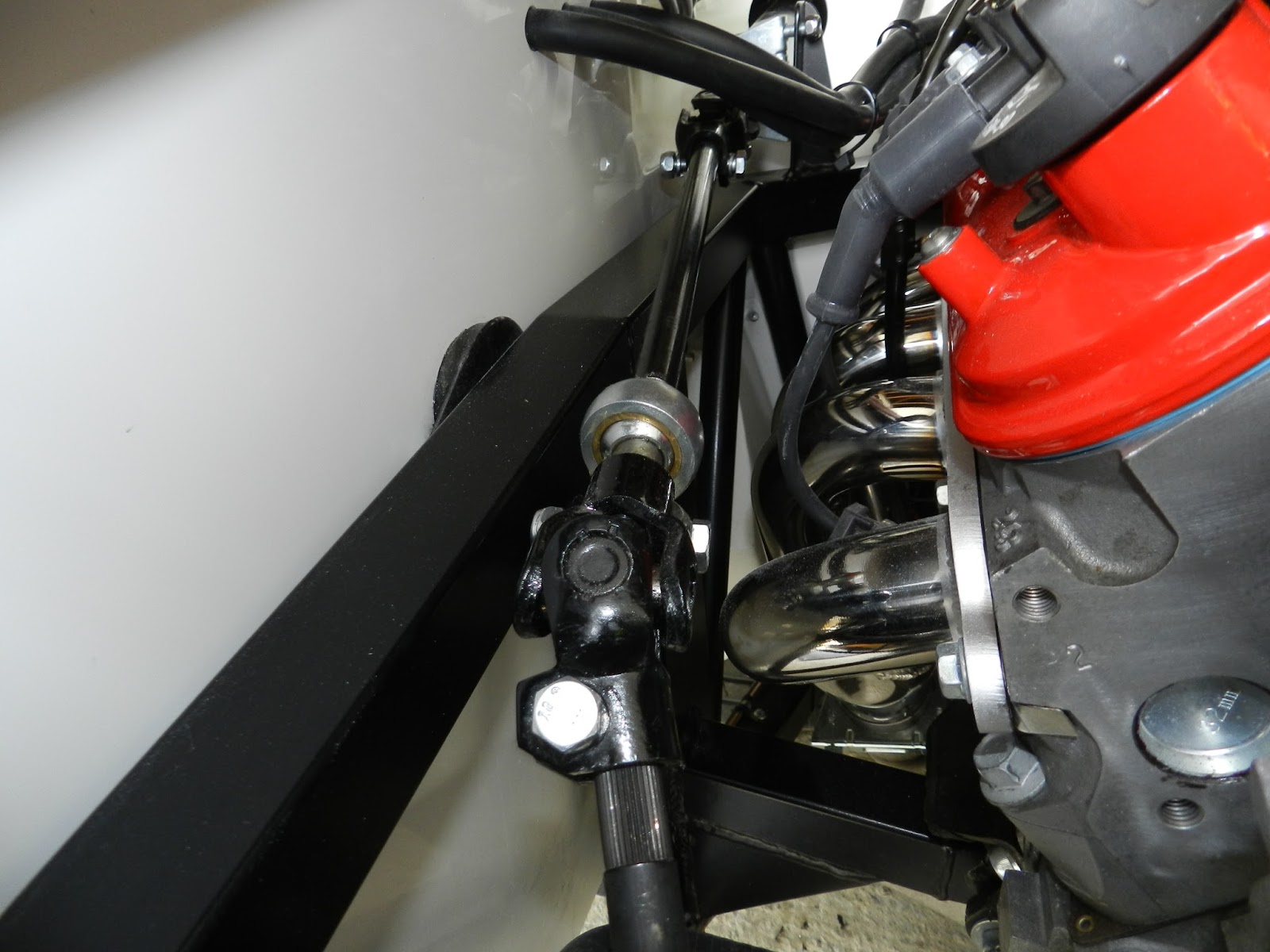
The lower shaft was connected to the steering rack, using one of the universal joints and two bolts. The middle shaft was connected to this lower shaft using another universal joint, after feeding through the rose joint that I had fitted earlier. At this stage the flats of the UJs were aligned. The pinch bolt groove was slightly enlarged by filing in the appropriate place and the bolt inserted. Finally the Vectra column was fed through from the cockpit, the large bulkhead grommet slid over and it was then located with the U clamp to the chassis. After working out the distance required between the middle shaft pinch bolt and the pinch bolt for the Vectra column, I cut about 10mm off the middle shaft using a hack saw and then tidied it up on the bench grinder. The final universal joint was then fitted and the groove for the last bolt filed, before washers were used between the column and the mounting points so that it cleared the bulkhead hole all around. All the universal joint nuts and bolts were then tightened.
Steering column spaced with washers on the mountings

Steering shafts and universal joints fitted
Finally I jacked up the front of the car and checked that there were no tight spots on the steering when turned from lock to lock. Job done!

Saturday, June 04, 2016

Steering column

I had the steering column in my boxes, so I thought it was about time I put it on the car.

There are three parts to the column. The lower section that connects to the rack. The middle section, with the rose joint and the upper Vectra section with the rake adjustment, collapsible mechanism and the electrical connections. At this stage all were fitted just hand tight with the nylocs, bolts and washers supplied

First I fitted the lower section. This was simply a case of removing the nut and bolt from the joint, then sliding over the rack splines and re-fitting the nut and bolt. This was required at each joint.
Connecting the lower section to the rack
Next, the middle section rose joint was packed with grease and connected to the lower section. The threaded part of the rose joint was mounted on the chassis bracket. NOTE: See IVA and Post IVA category in the Build Process.
Middle section connected to lower shaft. Rose joint can be seen here.
Finally, I fed the upper section through the bulkhead and the locating U-clamp from the passenger compartment and connected this to the middle section. Not forgetting to put the bulkhead grommet in place. Here I had to file the bolt cut out groove on the upper column shaft a little to accommodate the bolt, as the Vectra column has a smaller groove than required. A round file did the trick here.
Upper column connected to middle section.
Now I found that the column in the drivers compartment stuck out a little too far, so I could not fit the mounting bolts. This was even with the bolts hand tight in the joints. I suspect that it is simply a case to tapping the steering wheel end of the column to move the inner shaft in to the column assembly, but better check first. Advice has now been requested from Andy at GD!

Once the nuts and bolts are tightened up, I will need to make sure that there are no tight spots when turning the steering wheel. If there are the joints will need moving around the splines.

Sunday, April 03, 2016

Dashboard - part 5

So the gauges were in place. Just a case of wiring up these gauges and the switches!

I had not considered that there was a standard layout for the gauges and that the dasboard loom was made for this. Because I had come up with my own layout, this meant that I had to chop quite a few tie wraps and extend some of the cables. Also the billet switches for the start and hazard lights had smaller terminals, so I had to source these connectors and replace the existing ones.

I am not installing a clock, so the wires provided in the loom for this were not needed. As the ETB gauges do not need a voltage stabiliser, there were a further three wires that were not used in the loom. I connected the light green wires designed for the stabilizer to the darker green wire, so that the 'stabilised' gauges had a normal ignition 12v power supply.

Next I puzzled the Lucas type switches for the lights and heater. Six terminals, but only five wires - so what goes where? Each of the terminals on the switches were marked with a number from 1 to 8 (3 and 5 were not used, hence six terminals). Here Noel Hirst and Keith Akerman helped clear up my confusion with some photos.

I had realised that in the loom there is a red/white wire for each switch which is the illumination and a black wire for each which is the ground for the illumination. As there is no illumination on these switches, these wires can be ignored/not used (needed to make sure that there was no risk of shorting). So each switch just had three wires connected in reality. The light switch was wired as follows: brown/blue to terminal 1, red terminal 4 and blue terminal 8. For the heater it was: green to terminal 4, green/slate terminal 6 and green/yellow terminal 8.

Oh, and the Canems immobiliser! This is fitted to the rear of the dashboard, close to the steering column on the right side when seen from the driver's seat so that the fob can de-activate it. The unit is about 50mm square and needs mounting with the plastic surround against the dash (flat on, not on it's edge). I had not allowed for this and it was very tight up against the hazard switch, so if you are doing this be aware! Plan ahe.. I had to trim away some of the dash around the steering column to allow it to fit.
Immobiliser unit against steering column hole
I have decided to mount the remote trip/function push switch on the centre under dash cover. There is enough room to get your hand in between the lower part of the dash and the transmission tunnel to activate this. The remote switch comes with the ETB speedo and is part of the 'speedo loom'. This location saves having an additional item on the dashboard, which in my opinion, just clutters the thing. Some other makes of gauges have the trip switch on the face.

Apart from these issues, the wiring was fairly straight forward. I used the GD Dash Loom wiring diagram and the diagrams from ETB. Some of the wires were not used, so these were taped back on themselves, making sure that the conductors were not exposed. Others wires needed connecting to the GD loom, such as the speedo and tacho 'looms'. I have not given the full wiring, as this may differ depending on the gauges and switches used.
Spaghetti!
The column stalks have their own mini looms, which are not terminated at one of the ends. These mini looms connect into the relevant multiplug on the dashboard loom, but needed terminals adding to those wires that are used.
Terminals added to column connection multi-plugs