Showing posts with label Bonnet & boot. Show all posts

Thursday, February 01, 2018

Bonnet handles in place of locks ☹️

I wanted to keep clean lines on the Cobra, so I fitted low profile locks on the bonnet, rather than the traditional locking handles. I felt that my car would look better without the handles and still do. However, from a purely practical point of view, the low profile locks make the bonnet difficult to open. The handles do address this issue.

So I splashed out nearly £120 to address the practicality and thereby sacrificed the looks. I bought a set of handles and locking cams from Europa Spares - a benefit is that the bonnet and boot keys are the same. The four M4 raised head machine screws used to fix the handles came from Kayfast.

The existing locks were removed from the bonnet and the new handles were checked for fit. The existing holes were about 2mm bigger than required and had been squared off for the existing locks, but each hole will be covered completely by the handle fixing plate.

The locating pins on the handle fixing plate were removed, as these and the fixing holes were right next to each other, so would have weakened the fixing point. The underside of the fixing plate were then lightly filed to remove the excess metal left after cutting.
Locating pins removed from inner side of each hole on each fixing plate
The two fixing holes on each fixing plate were marked next to the existing holes, before drilling 4.5mm holes through the bonnet.
Two 4.5mm holes drilled each side of existing hole
The handles were temporarily fitted to the bonnet.
Raised head machine screws used to secure fixing plate

The cams were fitted so that the top edge was the same distance from the bonnet as the top of the locating slot.
Locating slot with escutcheon around it
They were then thinned slightly on the bench grinder so that they located in the bulkhead slots. This was a time consuming and faffy job!
Curved surface of cam thinned down 
Once fitted correctly, the machine screws were secured on the underside with nylon nuts and washers.
Bonnet handles fitted in place of locks (a shame)

The boot handle was a straight swap (apart from shortening the square bar) and it looks exactly the same.

Friday, January 08, 2016

Gas strut in boot

Boot stay

After putting off the installation of the boot stay, I finally committed myself to fitting in a gas strut. I had put off fitting the supplied strut, because I didn't like the GD strut or the method of fitting. So I created my own! However, like GD I have only fitted one stay, as I felt that this was sufficient for the boot lid weight.

The method of fixing is similar to that of the bonnet on my Cobra (see earlier blog). Again I bought the stuff (including a GSV8-200 adjustable gas strut) from SGS Engineering - a top company, in my opinion, with top service.

I had also bought a triangular bracket from SGS. This had a 10 mm ball fixing in place. A second bracket was made up using 3 mm thick angle aluminium, about 150 mm long, to strengthen the lip (fitted up behind the boot lip). The tip of the triangular part (see photo) was bent slightly, so that it touched the SGS bracket when in place (to add strength).
Bracket and angle aluminium that it was cut from
Two fixing holes were marked on the lip of the boot, using the SGS bracket, with the centre of the bracket about 160mm from the back of the cockpit side opening.
Two holes in side lip, seen from rear of boot
Using these two holes, the angle bracket was marked and drilled through and temporally fitted in place. Two pilot holes were then drilled down into the recess (around the boot edge), about 70 mm apart and through into the bracket to mark the hole centres. The bracket was taken off, then the holes carefully drilled out to size - I used M5 fixings. The two brackets were bolted in place, using button heads plus nyloc nuts. Edit: Forgot to mention that the two brackets were bolted together.
Two fixings in recess of boot lid surround
Bracket bolted in place, two bolts were also inserted in the recess behind the black sealing strip
Now I turned my attention to the boot lid fixing. Another SGS bracket was used here, also with a captive 10 mm ball stud. First the bracket was bent to the curve of the boot lid rib, before fixing in place using countersunk rivnuts and button heads. The open gas strut was used to find the location of the bracket
Bracket bent to curve of boot lid
Next I fitted the gas strut to the two ball studs, with the large diameter part of the strut attached to the boot lid (this will be lower than the other fixing point most of the time). Like the bonnet, the boot gas strut instructions recommend letting gas out in one second bursts. In my enthusiasm, I let out a little too much gas at around 19 seconds, so I will need to get it re-gassed! I had a spare locking mechanism from the bonnet attempt, so I used this as there was adequate clearance here.
Gas strut in place with locking mechanism
Looks a bit better than the GD strut and should be a little less rattly.

Hello and get well to Malcolm!

A friend of mine in Horsham is not feeling too well at the moment. We meet up a couple of times a year with him and wife Lin. We originally met in the South of France over 25 years ago, when we both had Citroens. Malcolm has driven my Caterham and I know he wants a go in the Cobra when it is complete, so I look forward to that blast in the 'beast', as he calls it! I know he looks at this blog on his big internet enabled tv.

Thursday, November 19, 2015

Engine and clutch parts arrived

Engine and clutch parts

It is 18 weeks since I collected the engine from Kyle at Tim Adams Racing Engines. It was 15 weeks since I returned the flywheel, clutch plate, clutch cover and alternator as they were not as agreed. After emails and phone calls, the replacement clutch and other parts have now arrived. The flywheel and clutch plate are good. The new belt tensioner, which was not on the engine when collected, has also arrived. However, the alternator is damaged and not as expected and I still do not have the dyno video.
Flywheel, clutch and alternator
I was expecting a used alternator, but got one with a broken plastic casing (the second one). I have now been offered to refund the cost of the alternator, but won't hold my breath. So I now need to source a new one. More money :(

The ECU, engine loom, immobiliser and the lambda sensors from Canems were as expected and their subsequent service has been second to none.

I can now get the flywheel, clutch plate and cover installed on the engine. The engine assembly can then be mated to the gearbox (once I have a modified clutch release mechanism from GD) via the bellhousing before fitting to the chassis. Also I have just received a new "hi-torque" starter motor from Roadcraft to replace the used one I had broken a contact on!
Shiny new starter motor
Bonnet gas struts

The other gas strut is now fitted. So that's another job completed, except for the locking mechanism!

Edit: I have changed the ball stud and this is better. It positions the strut more upright, however the locking mechanism is still too big to use. 
Second gas ram now fitted
A note of caution here on the bonnet. If you have the body on the frame and an electric garage door opener where the motor moves along the track - watch that the motor clears the bonnet when it is open. Mine didn't, so a bit more gel coating to do on the edge .....

Wednesday, November 18, 2015

Bonnet gas struts

I have decided to fit adjustable gas struts to the bonnet, rather than the standard GD opener, even though I have been warned off by GD. I have seen a number of Cobra type cars with them installed for both the bonnet and boot, including GD, AK and Dax, but I have not yet decided what to do with the boot.
Simon Smith's AK with gas struts
If the pressure exerted is too great, the GRP can become distorted. So I knew that I needed adjustable gas struts and brackets that would spread the load to avoid any distortion. After contacting SGS Engineering in Derby, I was convinced that I could install gas struts successfully, using my own brackets.

Using the bonnet stay purchased from GD, I calculated the length of struts to order. I decided that 8 mm diameter was adequate - this is the rod diameter. I then worked out the stroke and the extended length that I required, which was around 220 mm and 470 mm respectively. The nearest gas strut stroke that SGS offered in their NitroLift range was a 200 mm stroke with an extended length of 450 mm (measured to the shoulder of the cylinder) - part number GSV8-200.

The end fixings ordered were 10 mm ball stud type and this adds 25 mm to the end of the centre of the fixing, with an M6 male fitting. This will give an extended length for the strut of 500 mm (450 + 25 +25) and a stroke of 225 mm (200 + 25) which should be ok. The total cost was around £45, plus the brackets etc, so say £50.

To keep the bonnet stays open, with the bonnet lifted, I also ordered a safety lock for each strut. These did not fit - see later!

Thanks to Rob here for the guidance - see the link to his blog to the right of this article.

Lower fixing

To locate the strut to the inner wing, I made a pair of brackets from 25 mm angle 3 mm aluminium, with three 6 mm holes (one in the centre for the strut location/pivot point). The brackets were 250 mm long and fitted up behind the lip of the engine bay. One needed a small amount of filing as the return was slightly smaller.
Bracket with three 6 mm holes
The front of the bracket is located above the suspension cut out - just make sure that the central hole (the pivot) is at the same point on each side). With the pivot point here the strut should be upright when the bonnet is open. Before fitting the bracket, the position of the three holes were marked on the GRP and opened out to 6 mm.
Hole positions for the bracket
Each bracket was fixed in place with two M6 button head screws and nyloc nuts, the pivot from the gas strut and some No More Nails. Nut lock was applied to the pivot nut.
Bracket fixed in place
Upper (bonnet) fixing

The cylinder of the strut was positioned at the end farthest away from the body fixing point (nearest to the windscreen). The other end was fitted to the pivot point on the body. I then compressed the gas strut (after releasing the pressure for about 15 seconds [apparently this reduces the pressure from 700 N to around 250 N!] - but check your own struts for this) and marked the pivot position on some masking tape attached to the wing. The distance was 300 mm from the centre of the body pivot. I then transferred this to some masking tape on the bonnet.
Pivot position marked on wing and bonnet
For the top brackets, the ones that fix to the bonnet, I again used some more aluminium angle (I was going to use 'T' section to keep the load in the centre, but the fixings would not have been ideal on the bonnet ribs, as they are relatively narrow). I made the brackets 200 mm long and shaped them to leave a fixing lug at the centre for the ball stud pivot.
Off-side bracket
Four 6 mm holes were drilled in each bracket, two either side of the pivot. For the pivot point another 6 mm hole was drilled - 12-14 mm in from the 90 degree return of the angle (this is to avoid the strut fouling the capheads).  The brackets were then used to mark the holes to drill in the underside of the bonnet rib  for 6 mm rivnuts. The holes were drilled, the rivnuts inserted and then the brackets were secured to the bonnet with button head bolts.
M6 rivnuts in place
Once the strut had been fitted, the pressure was checked. The strut was adjusted by opening the hex adjuster for about one second at a time (this should be done the same amount on each side until the struts exerted just enough pressure to hold the bonnet open).
Strut from inside the engine bay
Strut from outside the car
Finally, I tried to fit the SGS locking tubes. These are designed to keep the bonnet open, even in winds. However, I found that the tube was too wide and fouled the body, so couldn't be used.
Locking tube fouled the lower mounting point when the bonnet was lowered
Now I just need to do the other side!

Tuesday, November 03, 2015

Boot lock, bonnet rubbers and fuel filler breather

This was a job I have been putting off!

Boot lock

First I marked the centre of the car (this is not as easy as it sounds!), then using the lock, handle and striker plate, I marked the square bar position in relation to the top of the striker plate (at this stage it is not possible to work out the hole location in the boot lid).
Centre line marked
The round bar on the striker plate was aligned with the edge of the square bar to the left of the centre line, so it was about 2.5 mm off centre (to the near side of the car) of the square bar.
Centre line with striker plate located. The striker bar looks further away from the centre line than it is.
The distance is half of the square bar to the near-side of the centre line.
An undersize hole was then cut (in case I made a hash of it) with the Dremel, where the claw of the lock would go. The striker plate was fitted to the car with button head screws and nylock nuts.

I then climbed in to the boot to mark out the position of the lock mechanism. The position was identified by hooking the claw around the striker plate bar and getting Carol to press lightly on the boot lid from outside (she let me out eventually). The lock fixing holes were then marked and drilled. After fixing the lock in place with self tapping screws, a 3 mm pilot hole was drilled in the boot rib, using the square hole in the lock as a guide.
Lock first fit and pilot hole drilled through boot rib
The pilot hole was opened out to 10 mm using a stepped drill, to avoid chipping the gel coat. A hole was then drilled through the outer skin, using a 3 mm bit from the boot side, which emerged very close to the centre line. Using the pilot hole, the external hole was then drilled to 20 mm.
The two holes (one in the outer skin and one in the inner skin) can be seen in the boot lid.
The outer skin hole was opened up to centralise and locate the handle. The slots were cut for the locating lugs. The handle was fixed with the two self tapping screws after the square bar was pushed through the lock.
Loosely fitted handle, square bar (too long at this stage) and lock.
The square bar was marked then removed with the handle. It was then trimmed to the marks so that it was flush with the lock. The lock was then finally refitted and the handle put in place.

Lock fitted in place and tightened up
A small amount of silicone was applied to the handle fixing, before final location. Nice feel when closed and locked!
Handle fixed in place
Whilst I was at it, I fixed the number plate light, where the chrome cover would not tighten up - the thread had stripped. Here I super glued a standard nut behind the hole on the light unit. The fixing bolt was then put in place and tightened.

Bonnet rubber strips

This was an easy win! 

The black sealing strip was fixed in place, using the self adhesive backing. It is not a continuous run around the bonnet shut line, but rather three separate strips. This apparently allows some ventilation and avoids the bonnet being raised too much above the body line, which a continuous run would do.

The edge closest to the windscreen was run from the edge of the curve of the bonnet shut line on the off side, across the car, so that it was equal length from the near side corner. See photo below.

The side strips were then cut to the same length as each other and fixed to the shut line from the end of the corner nearest the windscreen, towards the front of the car. See photo below.
Rubber seals in place
This raised the bonnet very slightly, but with a slight compression it allowed the locks to operate and close without any free play. Sorted!

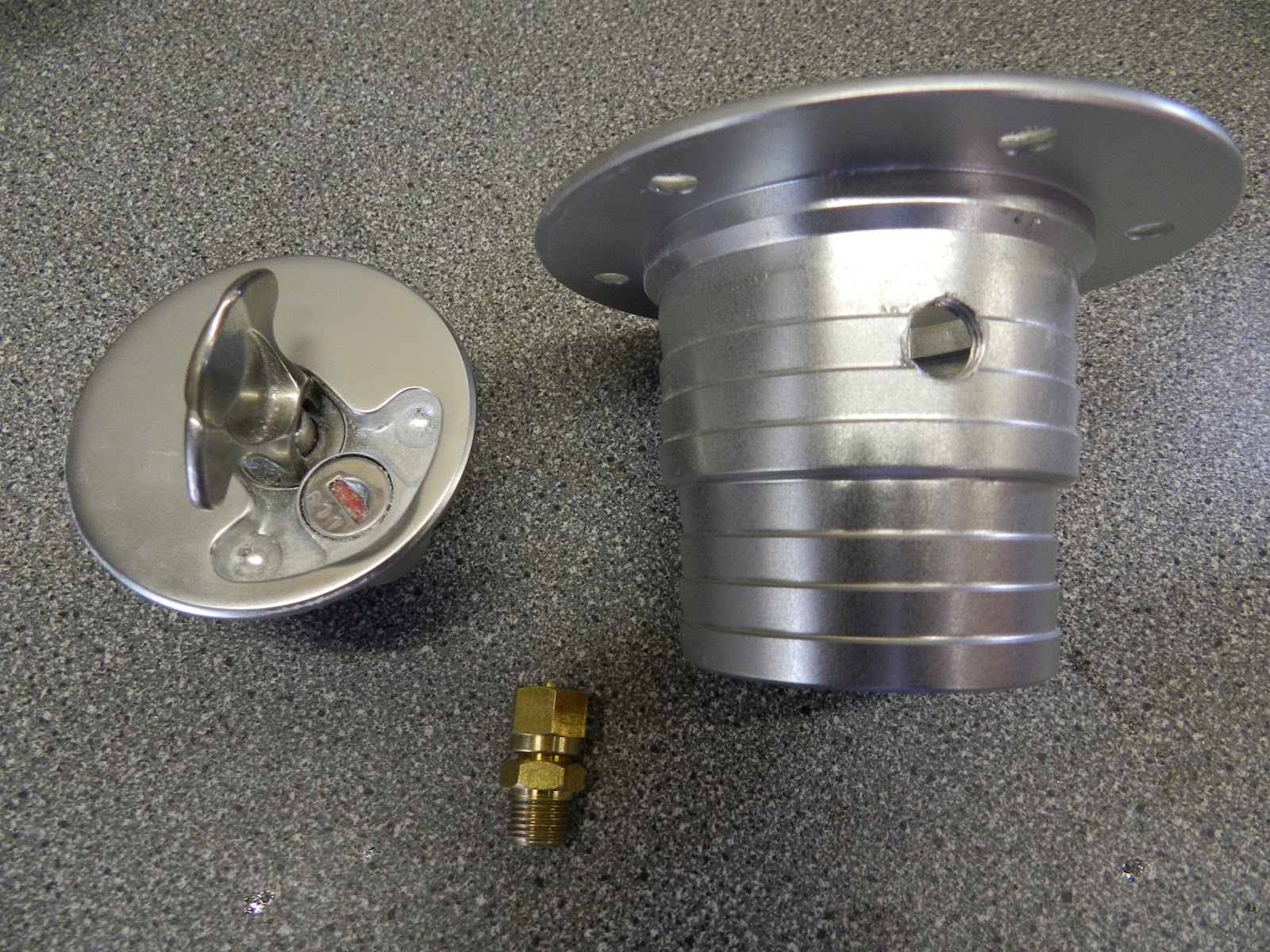
Fuel filler breather

A breather adapter was required for the fuel filler.

An 8 mm hole was drilled in the neck of the filler. Care was needed when selecting the position so that the cap would still fit and lock once the breather adpter was in place. The hole was tapped to 1/8 NPT. This may seem an odd thread, but I had a tap already in my Draper metric tap and die set!
Filler, cap and adapter
The filler cap was put loosely in place on the body. A small amount of nut lock was applied to the thread of the fitting before it was screwed in place. 
Breather hole can be seen in the neck 
The filler was rotated so that the breather was facing towards the drivers door, before fixing with the six fixings provided. 
Breather position viewed from inside the boot towards the off-side rear wing
Copper pipe brake pipe will be added later. This will need to be in an 'S' shape and use the compression fitting of the adapter. The other end will go through the boot floor - I need to remember to keep it away from the exhaust or Mr IVA will not like it. Don't think I would either if it ever vented fuel out there!

Sunday, October 25, 2015

Compounding and polishing the Cobra body

Another job that I wasn't really looking forward to. With hindsight, this should have been the first job after fitting the bonnet, boot and doors, that way I wouldn't have had to avoid lights, bonnet locks, vents and windscreen stay holes etc!

Front end

I carefully rubbed down the edges of the bonnet to avoid exposing the grey GRP underneath. After refitting it to the body, I decided to compound and polish the body. This is a messy and time consuming job, as the polishing machine throws off some of the compounding cream and there are three compounds to apply, before any wax. The idea was to do it before any other bits were fitted to the body, such as the windscreen and wipers.

After a final rub down of the body with wet or dry to remove any imperfections, especially from the bonnet, I used separate firm pads on the polishing machine for the G6 and G3 Farecla compounds. The compounds were applied to the pads directly from the bottle in a circle around the edge. You don't have to use too much. The pad was then lightly sprayed with water (you could spray the body instead), before spreading the compound across it with my fingers (I used throw away latex gloves whilst I did the polishing).

Medium firm pressure was applied to the machine, it was set to about 1500 rpm and tilted at a slight angle so that the outer edge was doing most of the work.
Polishing the rear
The compound was applied to the panel one way and then at 90 degrees to ensure all the panel was fully and evenly compounded. After each compound, the bodywork was cleaned up with a dry stockinette cloth. Contrary to what I thought, electric light showed up any marks the best. So most of the job was done in the garage. My advice here is don't be afraid, apply the compound until it virtually disappears and the surface is nice and shiny. If there are still marks, have another go or rub down again if necessary! You only need to do the specific area that has the marks.

Care was taken to avoid the polishing machine 'grabbing' the bodywork. If it did grab, then a little water was sprayed on to the panel. The finishing G10 compound was applied with separate lambs wool bonnet in the same way.
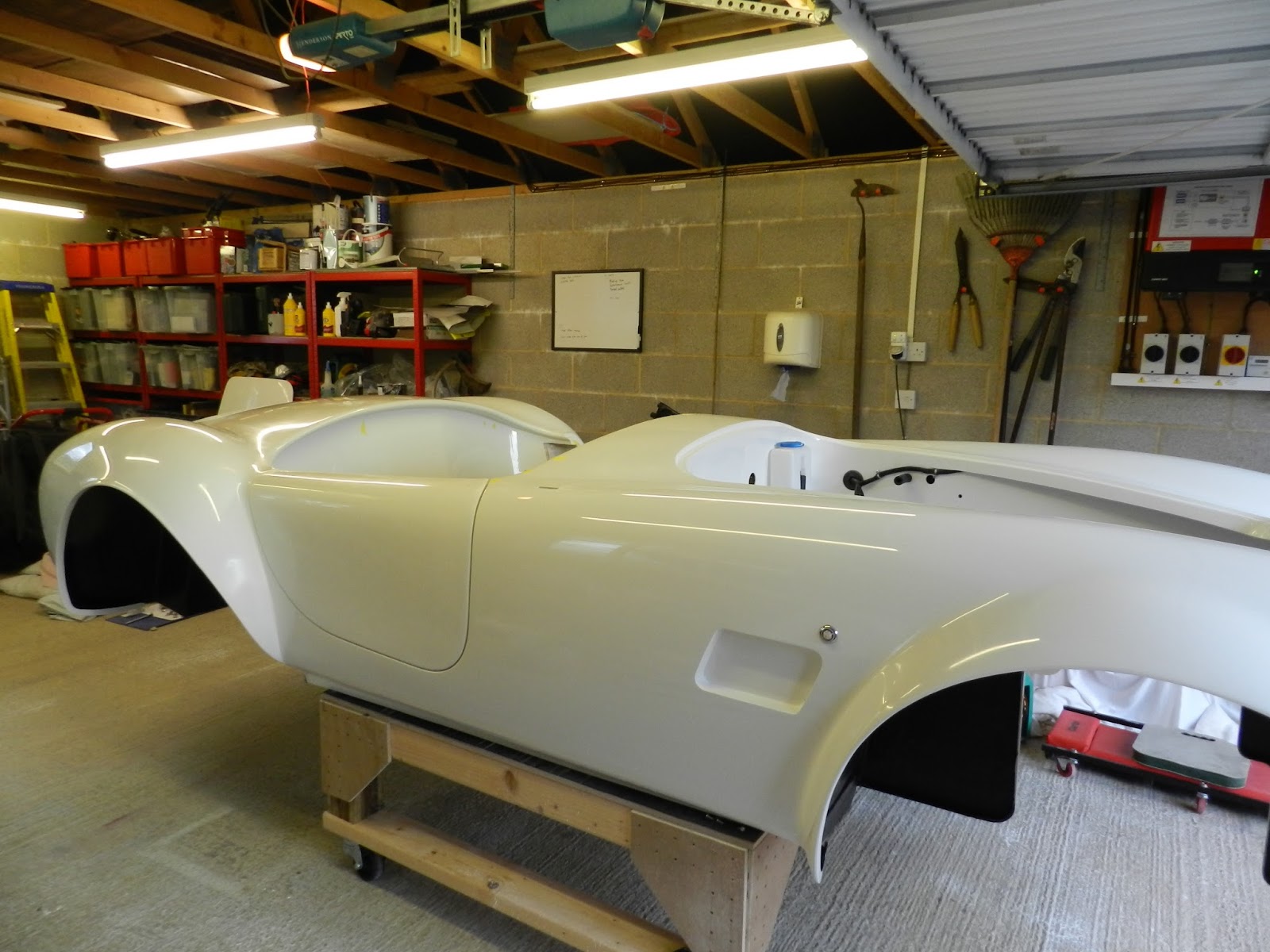
Front section polished. Only the doors and back to do! You can see the unpolished doors and rear end.
The result was great, as you can see from the above photos, although it did highlight a couple of imperfections that I wasn't totally happy with. They will be sorted out at the end (or they may get left), in case I make any marks during the build process! Then the wax will be applied.

Doors

These were finished off with wet or dry, after gel coating the tops. Again care was required here to avoid exposing the grey GRP. Once I was happy with the tops, the doors were polished up using the routine above.

Rear end

The edges of the boot lid were rubbed down to get a smooth finish and then it was re-attached to the hinges. The whole of the rear end, including the boot lid, was then compounded as above.
Shiny rear!
It took me two whole days to do the car - may be I am a slow worker!

Chassis

When I spoke to Andy at GD last time, he said that my chassis (a Euro) will be assembled at the end of the month, after Jonathan's is complete at the end of October. Jonathan is taking as much as he can initially, as he has to transport it to the Shetland Isle. Good luck with that then.

Oh, and Jonathan is starting a blog. I've had a quick preview and from the initial posts, it will be worth looking at. I will post a link here once he goes live with the blog.

Anyway, roll on early November to collect my chassis.


Tuesday, October 06, 2015

GD 427 bonnet and bonnet locks

Bonnet

Now to the bonnet. First I filed down the edge. What a dusty job!
The ridge along the bonnet edge before filing can just be seen
Ridge filed down ready for gel coating
The bonnet was not the best GD moulding. It had nearly 30 blemishes on the surface. They are marked up with dry wipe marker pen in the photo below. Many of the circles contained multiple blemishes.  

Bonnet blemishes marked
The edges of the bonnet were gel coated twice, before rubbing down.  The blemishes only needed one coat. The bonnet was then rubbed down and compounded with Farecla G6, before re-fitting to the body and lining up. This took hours.

Bonnet locks

I had decided on locks, rather than the traditional handles to keep the lines sleek and fuss free. The hole centres were not marked up by GD, so like the demist vent positions, I got them from Keith Akerman's car! Opening the bonnet will be a challenge I face. Hadn't thought of that - I may fit a spring to lift it a little or add a scoop to lift it with! Yet to decide.

I think the fixing process would be similar for fitting the handles as the locks, but check the measurements.

The hole centres are marked up on the bonnet at 41mm from the back of the bonnet, nearest to the windscreen. They are 680mm apart - 340mm each side of the centre line. Pilot holes were drilled in the bonnet, before 20mm diameter holes were drilled in the bonnet with the step drill. Because of the thickness of the bonnet and the depth of the steps, I had to drill from both sides.

Pilot hole drilled for the bonnet locks
The lock holes were taken out with the Dremel (I used the hole cutter bit to do this) to make them 21mm square (although the corners are cut off), to take the lock bodies. The locks were disassembled and then fixed in to the holes and the locating cams re-fitted to the square bars of the locks. I orientated them so that the key slots would run front to back of the car.
Lock in place in the bonnet
The bonnet was packed up to the level of the surrounding body. The cams were then  used to locate the edge of the slots to cut in the bulkhead (from the engine compartment). The escutcheons were used to mark the extent of the holes and these were marked out (again from beneath the bonnet).  The holes were drilled and again cut out with the Dremel cutter. The fixing holes were drilled for the escutcheons. The holes were not cut to the full extent of the escutcheon slots and were slightly narrower at the fully locked position to ensure that the bonnet was at the correct height. The escutcheons were then fitted, using two long screws and nyloc nuts.
Escutcheon fixed to bulkhead

Lock on underside of bonnet

View from inside the engine compartment

Monday, September 21, 2015

Brake pedals and other bits!

Brake reservoirs and lines

First I installed the reservoirs. I made a bracket to hold the brake reservoir, only to discovered that GD had supplied one!

The bracket was made of 3mm aluminium. A hole was drilled at the front of the bracket and through the webbing of the reservoir. The reservoir hole was made a little smaller, then tapped for the domed head bolt. The front of the aluminium was polished as this will be seen. At the back of the bracket I tapped the two holes so that the bolts through the bulkhead would tighten in to the bracket itself. The lower rear hole also went through the webbing of the reservoir.

The tops of the reservoirs were lined up before fixing.
Brake and clutch reservoirs, plus washer bottle
Next the fluid lines were temporarily installed (pipe clamps have been ordered). These are connected to the reservoirs, then fed through the holes drilled earlier in the inner wing.
Brake and clutch fluid pipes in place
Pedal box

My pedal box is of the fixed type (i.e. not adjustable, as the seats will be on runners).
Pedal box
I took the pedal box apart and bent the brake and clutch pedals towards the foot well extension a little (about 20 and 10 mm respectively). Then I marked the holes to cut, using the pedal mounting bracket as the template, allowing some space for the carpet at the left side. I have mounted the pedal box just a little lower than GD recommend (by about 8 mm), as I only have size eight feet.
Foot well marked up with hole positions
Next the brake light switch was attached to the bracket and the bracket fixed to the pedal box with two bolts and lock nuts. The master cylinders were offered up to the holes from the drivers side wheel arch compartment (Note: The two brake cylinders are different diameters internally, so don't mix them up). The pedal box was offered up from the drivers side foot well. The bolts and lock nuts supplied were then used to attach the master cylinders to the pedal box. Extra hands are needed here and a very flexible body/contortionist techniques. Getting the bolts in place was a real pain!
Brake (x2) and clutch cylinders in place 
Pedal box from the foot well
You will see that I have a brake balance bar and two brake master cylinders, so that the brake pressure can be set from the front to the rear. Previously a single cylinder did this work, but was not adjustable. The brake bias bar will be fixed using lock nuts to comply with IVA requirements.

Next job is to tighten up the securing nuts/bolts, fix the clutch clevis pin and the brake bias bar. More contortionist positions!

Polishing

Looked at the body and I wasn't happy with the polishing I had done (contrary to what I said in the last blog). So it was out with the polishing machine and the Farecla again. A little more pressure on the machine this time, some water sprayed on the surface to stop it grabbing and it is definately ok now. The polishing head has a firmer foam this time (I wrecked the last one on sharp edges), so I needed to press on the machine to distort the head a little to get the right pressure. I also rubbed down the gel coat repairs on the boot and polished that too with the machine and Farecla G6. The doors were re-fitted, rubbed down and polished too.
Boot rubbed down and first polish
Final polishing with Farecla G3 and G10 will be required to finish off the body. It may then require a wax all over. Looking forward to that .... not.

Gel coating

Finally getting there. Remember that awful joint along the tops of the doors? Well they are nearly invisible, so another coat of gel and just one more rub down should do it. Famous last words!

The few remaining marks on the body were gel coated too and left to set.

Doors

The passenger door was refitted. Washers of different thicknesses were used between the door skin and hinges to get the doors flush with the body. The drivers and passenger doors were re-fitted and lined up. Looks good now. Just need to source some springs and fit them to help the door handle return to its normal position.
Doors fitted, lined up and first polish