Showing posts with label Gel coat and flash lines. Show all posts

Friday, October 09, 2015

Body, brake bias and power take-off studs

Preparing the body

Don't underestimate the time required to gel coat and rub down the body, doors, bonnet and boot. Don't get me wrong, it is not difficult, but it is time consuming. Applying the gel coat is like painting with gloopy Dulux. You let it dry, then rub down with wet or dry.

I seem to have applied loads of gel coat and spent hours and hours rubbing down and once done, it requires more rubbing down! Most times, no matter how much care I have taken, I seem to have gone too far and exposed the grey GRP below the gel coat, usually at the edges.

So don't be afraid to apply a thick coat of gel, especially along the door top and any edges. These seemed to require a lot of gel and rubbing down to get the right shape.

Now it is almost done, or at least I think it is, but no doubt more gel and rubbing down will be required!

Brake bias bar

The brake bias bar needed about 2mm of free play on the pedal. However, mine when I first fitted it, was solid up against the pedal box. Andy recommended that I take some metal off the threaded bar.

I needed help to remove and refit, as the fasteners are in the foot well and the compartment behind the wheel arch. Matthew, my son-in-law came to the rescue after doing his fatherly duties, including the school run.

Matthew undid the nuts whilst I held the screws from the foot well side. The brake bias bar was set with the clevis fixings at 60mm apart and equidistant from the ends. The master cylinder threaded bars were ground down by about 7mm each (after much trial and error - well hopefully not the latter) and refitted. The cylinders were attached to the brake bias bar by Matthew screwing the cylinders in to the clevis from the compartment.
Brake bias bar, with brake switch above it
This took a few attempts to get the length right, so it was a bit of an hokey cokey job .... in out, in out! Finally the length was ok, so the cylinders were fixed in place with the help of Matthew.

The brake pedal height was set 25mm below the accelerator height. This allows for heel and toeing, when changing down a gear.
Accelerator set about 25mm below the brake pedal
Power take-off studs

M10 bolts, nylocs and ordinary nuts were ordered from ebay. The battery cables were attached to two of the M10 bolts and a washer added to each. The studs were passed through the 10mm holes drilled from the engine bay into the compartment behind the nearside wheel arch.

Attached to the top stud was the negative (black) cable and to the bottom the live (red) cable. These cables will eventually be attached to the battery.
Cables connected to studs
The studs were fixed in place with normal nuts in the engine bay, to clamp the studs in place. The two cables with the rubber covers will be attached to the appropriate studs in the engine bay. These cables will then be secured to the studs with the nyloc nuts.
Power take-off studs in engine bay

Thursday, September 17, 2015

Polishing and gel coating today

Rubbed down the gel coat repairs on the boot surface and the roll edge around the cockpit today.  I could see three marks remaining on the boot, plus some around the door opening, so these have been gel coated again.

Then spent a few hours polishing the back half of the body with the polishing machine and Farecla G6 so that I could see any remaining blemishes. Really pleased with the result of the polish (Edit: Now I have seen it in electric light in the garage, it is not as good as I thought!) even if it is only the first of three grades of compound I will use. I have not polished the boot yet (due to the new gel coat) as you will see in the photo below.
Back of Cobra polished, but boot still to do
I refitted the drivers side door, after rubbing down the gel coat on the edges of both doors. Spent time getting the gaps around the door consistent. I used washers between the hinges and the door to get the door level with the body. Will re-fit the passenger door the next time I do any work on the car. 
Door refitted, but not polished yet

The top edge of the door, where the two skins come together, will have the new gel coat rubbed down when both doors are re-fitted. It may need some further gel coat applying.

Friday, August 14, 2015

More gel coating and polishing

I have plucked up courage to tackled the edge of the doors. You can see where the outer skin is bonded to the inner skin. This shows as a pink line all around each door. After filing, this edge needs rubbing down with P400 wet or dry paper. It is then coated with a couple of coats of gel.

First coat of gel applied - doesn't look good!
The second coat made it look better. It is then rubbed down with P800 then P1200, to create a smooth rounded edge.

Next I rubbed down the gel coat that I had done the other day. Most was ok, but some of the imperfections should have been gently ground out before I applied the gel coat. As a result, the rubbing down exposed the original fault.

I polished all the front bodywork, excluding the bonnet, using the polishing machine. I wrecked the foam mop head on the wheel arches and especially the light apertures. So with hindsight, I should have polished the body before I cut any holes to minimise this risk. I used Farecla G6 and then G3 and I am really pleased with the results.
Gleaming bodywork!
Now the front bodywork is polished I fixed the grills in place using the Car Builders Solutions adhesive. It is applied by a silicone gun and is available in black and white.
Oil cooler grill fixed in place
Then I took note of Keith Townsend's blog and trial fitted the front registration bar, as it is awkward to do once the body is on the chassis. The bar is bolted between the two inner wings and is a requirement of the IVA test to reduce the size of the opening and is also used by GD to mount the registration plate. I measured 120mm from the bottom of the radiator opening to the bar to get the position. A couple of washers were used on each bolt as packing, as the inner wings were a little wider than the bar.
Front number plate bar fixed

Wednesday, August 12, 2015

Bonnet and first gel coat

Today I fixed the bonnet. Sounds easy. Just two hinges fixed by four bolts. 
Bonnet hinge from inside engine bay
However, it took a lot of fiddling to get the shut lines the same all round. The hinges needed bending and I enlarged the holes on the hinges by 2mm to allow for minor adjustment. But it was well worth the time.
Consistent shut lines
There were a lot of small indentations, pin holes and marks on the body after rubbing down. So I tackled the gel coat for the first time. First I identified every mark with tape, where some gel coat was needed. This was to make sure that I touched up all the areas required. I had been told that the mix was 3% of the activator to 97% of the gel coat. Then I mixed the gel coat and activator, using a syringe from childrens Calpol to measure out the small quantity of activator.
Difficult to see the imperfections from the photo, but they are there - honest.
Areas that were relatively flat were rubbed down with P400 wet or dry paper. I covered some with cling film and left some others exposed to test if it made a difference. I have heard stories of the gel not setting, however the weather in these cases was cold. It is over 20 deg C today, so we will find out if the mix is ok and whether cling film makes a difference.


Thursday, August 06, 2015

White stripes! Flash lines and doors

Well I was warned by Keith Townsend's Cobra build blog (see link on right). Using a polishing machine, Farecla and a fine spray of water, I managed to create a white stripe down my blue overalls and along the garage floor. Oh well, it's all part of life's rich tapestry as they say! 
White stripe from waste to shoe!
As you can see I was impatient and wanted to see if I had fully removed the flash lines. I had! Below is the off side front wing, with a nice deep shine after only using G6 Farecla.
No sign of the flash line thank goodness.
Next I turned to the door fitting. The holes were pre-marked by GD, so were cut out with the Dremel and electric drill.
The holes cut for the hinges. Once the GRP was removed, the hole was filed out.
The video GD Cars provided shows the hinges being fed in from the inside of the car. I didn't do this, instead I fitted the hinge mounting plate first on to the bonded-in post, then fed the hinges through the holes from the outside.
The hinge mounting plate from the inside
Next I assembled the door metal work. This includes the hinges, intrusion bar, the remote opening mechanism and the lock. I will either paint or have the parts powder coated once I know that they fit. A bag of assorted nuts, bolts and washers was supplied by GD Cars. Whether I have used the correct ones, only time will tell.
Door metal work trial fitted
So the next job is trial fitting the doors and getting them aligned.

Wednesday, August 05, 2015

Flash lines

Well all the body flash lines are sorted (at least in theory!). It has taken about 20 hours of work, but it is quite satisfying, if physical work. Although it is not difficult if care is taken.

There are some bits of gel coating to do, where I have exposed the grey GRP below the white top coat. The main areas are the joints on the wheel arches and boot. See below. These will need taking back a little with the Dremel, before gel coating.
Exposed grey GRP
Some small brush hairs from the laying up process have been exposed in the gel coat too. These have been rubbed out, but over the near side rear wheel arch this has allowed the grey GRP to show through. According to Andy at GD Cars I can apply a couple of coats of gel directly to the area, as long as the surface is adequately keyed (ideally with P800 wet or dry).
If you look carefully you can see the grey through the gel coat at the top of the arch
I intend to try some gel coating to cover up the imperfections next. The doors, bonnet and boot are still to rub down, but these will be prepared after I have trial fitted the items.

Saturday, August 01, 2015

Cobra body preparation - flash lines

Now this was a job that I was not looking forward to having read a number of blogs. However, it has turned out better and easier than expected. First I tackled the rear off-side. Why? Because others had done that! Saves making a decision .....

Having talked to Andy at GD Sports Cars, I was armed with a number of tips. So here's what I did.

I masked off the flash line leaving about half an inch either side. I then used masking tape to cover up most of the hand file, leaving only half an inch or so exposed. The flash line was then filed down very carefully in the direction of the flash line (horizontally). The masking tape thickness made sure that I didn't mark the body.

Panel masked off - area to rub down is between to tape lines
I then made a small block from wood and using P400 wet or dry paper, I gently rubbed down the line using plenty of soapy water, again going in the direction of the flash line only (horizontally). I used 3M wet or dry as recommended by Ryan (see his blog linked on the right), as it is more consistent and less likely to create deep scratches, although it is more expensive and harder to get hold of.

The masking tape was removed and some new tape applied half an inch further out. A new sanding 'block' was then made of high density foam (GD recommend a piece of rubber belt).

The wooden block on the right and the high density foam on the left
The area was then rubbed down at 45 degrees to the flash line using P800 wet or dry using plenty of soapy water. The process was repeated going at 45 degrees to the flash line the other way. Then I rubbed down horizontally.

Finally the masking tape was removed and the area was blended in using P1200 wet or dry, plenty of soapy water and a cork sanding block. I rubbed down at 45 degrees to the flash line, then 90 degrees (vertically) and finally horizontally. I was reminded by Andy that the body was very curvy, so I should not create any flat areas.
The finished panel prior to polishing
The whole thing took just 45 minutes. Very satisfying! Now the area just needs buffing with the polishing machine and Farecla. So if this is a good example, then the job may not be too difficult.

Thursday, July 30, 2015

First day in the garage!

Thought that I had better tidy up a little, so that I could find things ...... some hope! So some parts were put on shelves and others in the car body.

Once things were out of the way, I set to work on an easy job - removing the very sharp flash lines. This is where the gel coat has seeped out of the mould joints such as around the wheel arches, bonnet and boot. These are removed very carefully with a fine file and with fairly course wet or dry (I used P80). Use thick gloves to avoid cuts!

The removal of the flash lines on the body (where the two halves of the mould meet), will be left for another day. This sounds like a much bigger job!

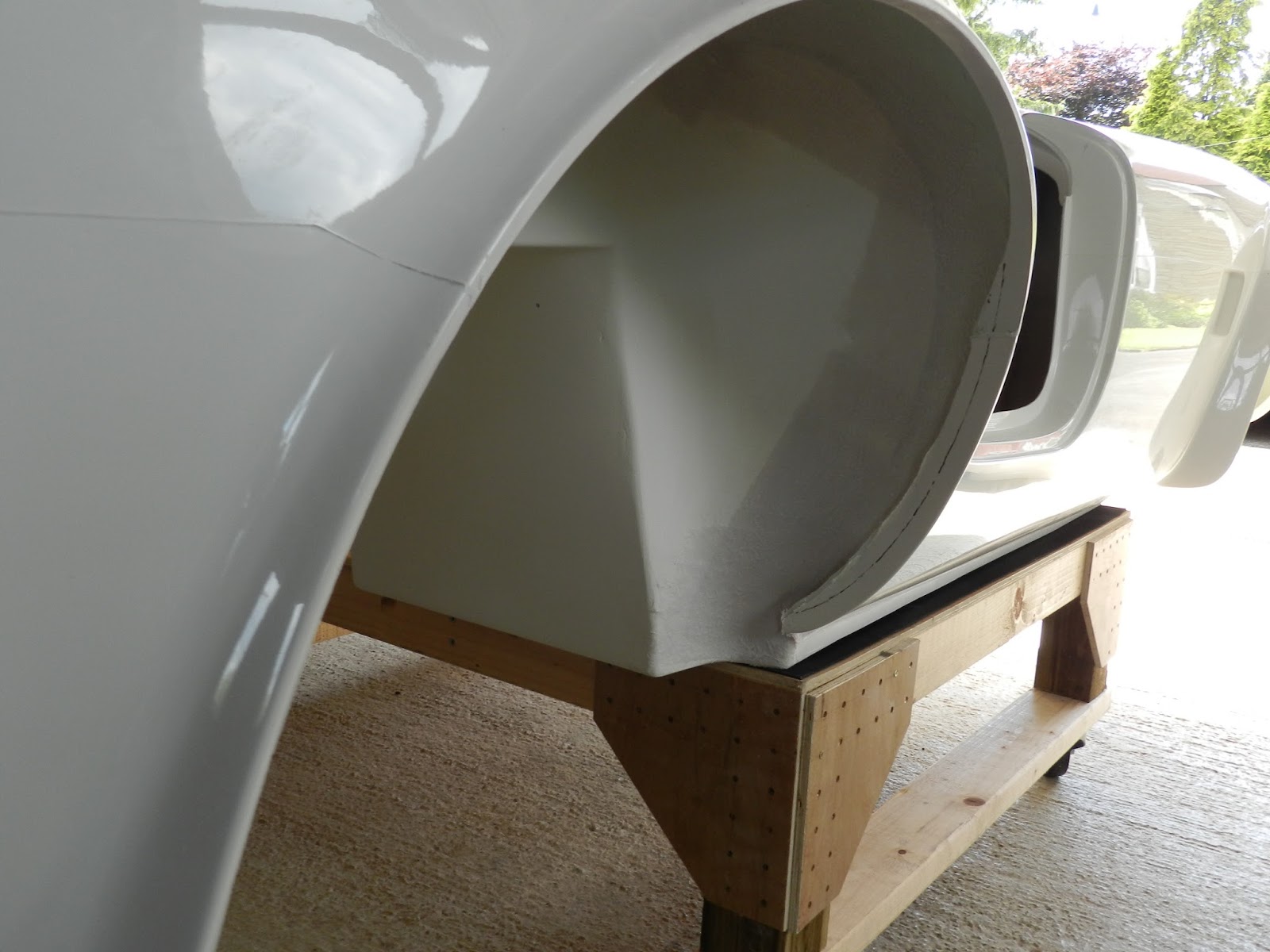
Here are three photos of the initial body rear wheel arch, the arch when filed and then one when cut back with the Dremel.
Look carefully and you can see the sharp flash lines around the wheel arch edge
The wheel arch with the sharp flash lines removed by a file and course wet or dry paper
Once the basic prep was done, the wheel arch return was cut back using the Dremel, then rubbed over with wet or dry.

The wheel arch trimmed back - note the consistent width of the return
All sharp edges have now been removed from the body. An easy job, I just needed to take care not to file or rub the polished body!