Showing posts with label Steering. Show all posts

Sunday, May 14, 2017

New wheel!

Well I have finally got round to getting a slightly bigger steering wheel. I have gone for a 14" (previously a 13") premium grade leather traditional style, with nicely polished and radiused edged spokes. The wheel is flat, rather than semi-dished and has a slightly thicker rim and was bought from Scarborough Racing Developments.

The only issue was that it was a 9 hole fixing and the previous wheel was a 6 hole fitting. The advice was to temporarily fix the wheel with 3 bolts through the holes that still lined up, then drill the remaining 6 holes through the boss. The steering wheel was then fixed with the 9 countersunk fixings screws, washers and nylocs provided, putting the central circular ring supplied in place. An easy upgrade!
New steering wheel fixed

Friday, March 31, 2017

Self-cancelling indicators

I had realised how reliant I was on the self-cancelling indicators on my day to day car. So without them I was leaving them on in the Cobra after turns. I even had a biker draw level at some traffic lights and say "Your indicator is still on mate". So I thought that it was about time that I did something about it.

It is an easy mod. that I should have done earlier. But I hadn't! Here's what I did:

I applied masking tape to the shroud and marked the straight ahead position of the steering wheel and that of the indicator self-cancelling stub (this little bit of plastic can be seen within the hole at the 10 o'clock on the column, when the indicator stalk is in the on position).
Straight ahead and self-cancelling stub position marked
The boss was removed from the wheel, then I carefully marked where I needed to drill holes for the pegs (about 12mm either side of the stub) and clear of the shroud hole. The pegs were cut from 4mm aluminium dowel that I had bought from Wickes.
Pegs in position in the boss
The boss was put on to the column when each peg was inserted in to the drilled hole. After both pegs and holes were done, I fixed the pegs with superglue (they are a friction fit) to ensure that they did not come adrift. Finally the steering wheel was re-attached to the boss and then secured to the column. A road test confirmed that the modification had worked and that the pegs did not foul against the shroud.
Steering wheel back in place.
   Another job done!

Wednesday, January 18, 2017

Dashboard and steering column shroud in place

Took off the steering column shroud today, after yesterday's work.

The electrical connections around the column were interfering with the shroud, so I gently bent a couple of connectors on the switch and some of the wires. I removed the insulation from the main ignition connector. Once the connector was exposed, I crimped this on to the cable and insulated it with tape.

Getting the shroud and stainless steel cover in place was interesting/frustrating. It is a friction fit around the column and in to the cover. It was hard to locate it properly without crumpling the leather at the edges. After a bit of squeezing, pushing and pulling, it went in to place and could be fixed with button head bolts to the plastic mounting. The leather is persuaded to go through the dashboard hole, but is not glued in place. Watch where the cables go, as it is easy to trap them or route them incorrectly. It is also easy to pull off connectors when doing this!

Next I fitted the under dash trays. again I had to watch that I didn't trap any cables. The trays are located between the lower part of the dash and a cross member. The end nearest the bulkhead is fixed with self tapping screws.

So this is the finished job .... or so I thought.
Dashboard in place
I then tested the electrics again and I have clearly disturbed some wires in the process. It appears to be an earth issue, so Paul will be called in to sort out my clumsy work!

Monday, December 26, 2016

Steering column - switches and wiring

This is the second part of my steering column switches and wiring post.

The switches were removed from the column mounting. The original stalks were cut off above the rubber gaitor locator towards the stalk end - see the photo below.
Cut stalk alongside an in-cut one
The end of the 'switch stalk' was then filed flat, drilled and tapped to take the replacement GD stainless stalks. The plastic flange that locates the rubber boot is at a slight angle, so the hole needed to be drilled to take account of this.
The plastic flange that the rubber boot is located on. Note that it is not 90 deg to the stalk
The new turned stalks were screwed in and a small amount of 'loctite' used to make sure they do not work loose. The column adjuster was fitted and a small grommet fitted to the leather to finish it off. This was glued to the leather to keep it in place.
New stalk fitted
The wires were connected to the column switches using the wiring diagram from GD. I will come on to the ignition switch later.
Wiring for column connectors
The wires have had female crimp connectors attached at the ends of the cut wires. Connectors are attached at the other end to link to the the dashboard loom using the block connector.
A switch with the wires connected
Don't push the switches fully home on the steering column at this stage, as they will need to be removed to install the dashboard.

Saturday, December 24, 2016

Steering column - leather, trim and switches

Managed to get a couple of hours on the Cobra today before Christmas.

Stainless steel shroud

The leather was cut to an approximate length to go around the shroud and the thickness of the shroud marked with chalk.
Metal shroud and marked up leather (the area to glue is nearest the camera)
Contact adhesive was applied to the metal shroud and leather (within the chalk mark). After 'drying the contact adhesive' the leather was fixed to the metal shroud. It was then trimmed to expose the control stalk holes.
Leather glued and fitted to metal shroud prior to being trimmed
The shroud was tried in the stainless steel trim plate and needed a small amount removing with metal shears at the joint.

The plastic mounting needs to have the two pre-drilled holes opening out a little and then tapped to take M8 threads. I used a 6.5 mm drill bit to open out the hole and a sharp M8 tap to create the thread.
Tapping for the M8 thread
The old mounting brackets (plastic below and metal above) were removed.
Old brackets removed (lower bracket already done)
Next the ignition switch barrel was removed. This is achieved by turning the ignition key clockwise one click to position one. A thin allen key is inserted in the small hole just above the barrel (see photo below) and the barrel just pops out.
Hole to release ignition barrel
The leather on the shroud was cut to the indicator and wiper switches using a craft knife. The shroud was then fed over the column. The switches were then put in place on the column. The stainless steel stalks will be fitted later.

The stainless steel trim plate was fitted to the column and over the shroud using M8 buttonhead bolts to fix it. The leather covered shroud is a friction fit to the stainless steel trim plate, so does not need any fixings.
Old type stalks in place (they will be replaced)
On the plate are operating symbols for the lights, wipers, horn etc, so the stainless steel GD stalks can be fitted before the IVA.

The leather was trimmed around the inside of the ignition barrel.
Leather cut around the barrel

Sunday, August 28, 2016

Finishing off and getting started again!

Cabinets

I spent hours cutting and putting ribbed matting in the bottom of all the drawers of the cabinets and the tool chest. I had found that anything else that I used moved with the weight of the tools, including the lining stuff supplied with the tool chest by Halfords, when the drawers were opened and closed. This was a real time consumer, but worth it in the end. The ribbed matting came from eBay and cost nearly 25% of the cost of the same product from one of my regular on-line parts suppliers!

Mirrors

I finally got the bench grinder and vice fitted to the new work bench.

The windscreen fixing screws on the stanchions were dome headed. The second screw up from the body at each side are located behind the mirror bracket. These had the head filed flat so that the bracket would sit flat on each stanchion. After filing, the screw still had the slot in the head to allow it to be fixed and tightened. A light rub down with P400 wet or dry paper removed any file marks.

Next the four screws that held the mirrors in place were shortened by 6mm each, to avoid touching the windscreen when tightening the mirror brackets. I had been warned that if the screws were too long I risked cracking the screen, ooooh expensive, so care was needed here.
Mirror fixed in place. Note the hidden screw behind the bracket, with the flattened head.
Steering column

Andy at GD had recommended that one of the shafts was shortened and a groove filed to allow the bolt to fit through the universal joint. As a last resort I could tap the inner column in to the main Vectra column. I chose to follow his advice and did the former.

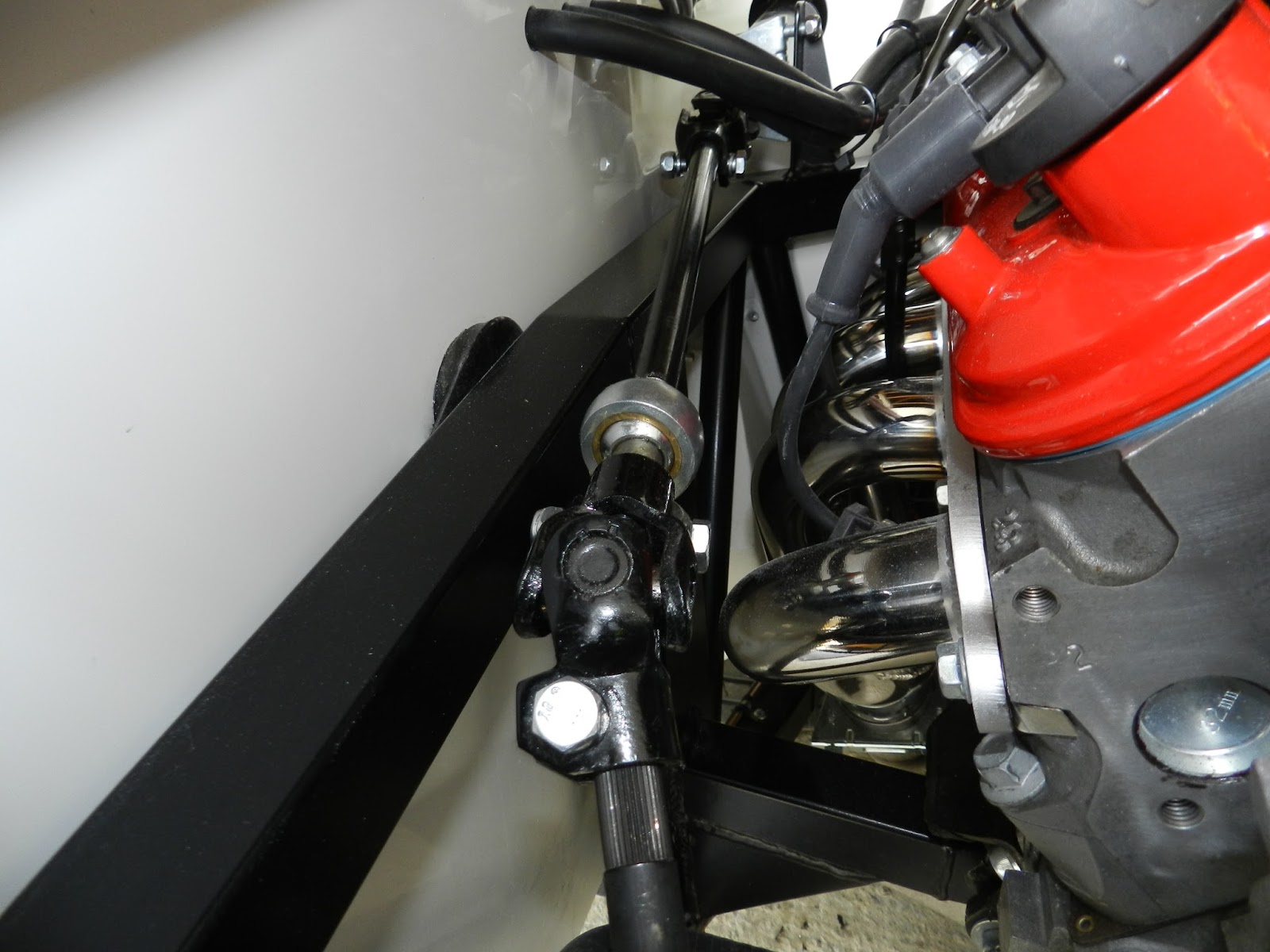
The lower shaft was connected to the steering rack, using one of the universal joints and two bolts. The middle shaft was connected to this lower shaft using another universal joint, after feeding through the rose joint that I had fitted earlier. At this stage the flats of the UJs were aligned. The pinch bolt groove was slightly enlarged by filing in the appropriate place and the bolt inserted. Finally the Vectra column was fed through from the cockpit, the large bulkhead grommet slid over and it was then located with the U clamp to the chassis. After working out the distance required between the middle shaft pinch bolt and the pinch bolt for the Vectra column, I cut about 10mm off the middle shaft using a hack saw and then tidied it up on the bench grinder. The final universal joint was then fitted and the groove for the last bolt filed, before washers were used between the column and the mounting points so that it cleared the bulkhead hole all around. All the universal joint nuts and bolts were then tightened.
Steering column spaced with washers on the mountings

Steering shafts and universal joints fitted
Finally I jacked up the front of the car and checked that there were no tight spots on the steering when turned from lock to lock. Job done!

Saturday, June 04, 2016

Steering column

I had the steering column in my boxes, so I thought it was about time I put it on the car.

There are three parts to the column. The lower section that connects to the rack. The middle section, with the rose joint and the upper Vectra section with the rake adjustment, collapsible mechanism and the electrical connections. At this stage all were fitted just hand tight with the nylocs, bolts and washers supplied

First I fitted the lower section. This was simply a case of removing the nut and bolt from the joint, then sliding over the rack splines and re-fitting the nut and bolt. This was required at each joint.
Connecting the lower section to the rack
Next, the middle section rose joint was packed with grease and connected to the lower section. The threaded part of the rose joint was mounted on the chassis bracket. NOTE: See IVA and Post IVA category in the Build Process.
Middle section connected to lower shaft. Rose joint can be seen here.
Finally, I fed the upper section through the bulkhead and the locating U-clamp from the passenger compartment and connected this to the middle section. Not forgetting to put the bulkhead grommet in place. Here I had to file the bolt cut out groove on the upper column shaft a little to accommodate the bolt, as the Vectra column has a smaller groove than required. A round file did the trick here.
Upper column connected to middle section.
Now I found that the column in the drivers compartment stuck out a little too far, so I could not fit the mounting bolts. This was even with the bolts hand tight in the joints. I suspect that it is simply a case to tapping the steering wheel end of the column to move the inner shaft in to the column assembly, but better check first. Advice has now been requested from Andy at GD!

Once the nuts and bolts are tightened up, I will need to make sure that there are no tight spots when turning the steering wheel. If there are the joints will need moving around the splines.