Showing posts with label Windscreen. Show all posts

Tuesday, August 08, 2017

Wet passenger legs!

We had a drop of rain on the North York Moors Cobra Club run. If we went fast enough the rain went over the top of us, unfortunately I had not sealed the windscreen stanchions properly and it dripped in to the passenger foot well. Not too bad as it was on to the passenger's legs and not mine!
Gap down side of stanchion let water in

In addition the rubber seal of the windscreen had a kink in it, so GD had supplied a new one without the fault.
Kink can be seen in photo above
So I had to remove the screen. This is a time consuming job, as you need to remove the sun visors, mirrors, wind wings, centre bracket, before unscrewing and lifting out. But a tip, remove the passenger under dash tray and one of the bigger gauges on the dashboard. Now you can get your hand in to remove the nuts holding in the central screen bracket. This is a lot easier than removing the whole dash!

Whilst the screen was off I re-did the drivers side stanchion sealing. The escutcheons needed removing to do this job properly. The new rubber seal went on easier with some Vaseline to aid sliding in to the channel on the under side of the windscreen.
Stanchion re-sealed
New rubber seal without the kink!
So, hopefully dry legs now. Not that it goes out in the rain .... well it is not planned anyway!

Saturday, January 14, 2017

Preparing for start up

Preparing the engine

The engine has not been run since it was collected - almost 18 months ago. So before I attempt to start it, it needed some lubrication.

I had spoken to Andy at GD and to the engine builder. As the engine had run on the dyno it wasn't a first start, so oil would still be present in the pump. The advice from the engine builder was to remove the rocker covers, then add a litre of oil to each side. The oil was poured over the rockers/lifters, springs and down the pushrod bores. The latter required a "pump action" oil can to squirt the oil in to the pushrod bores, which are above the rocker assembly. Once this was done the rocker covers etc were re-fixed to each side and the engine left overnight so that the oil drained down and lubricated the top end of the engine.

Tomorrow, after checking for leaks, I will add the rest of the oil to the engine. Then I will remove the plugs, disconnect the ECU and turn it over until I have oil pressure. Lots of max 20 second bursts is best for the starter I have been told.

Wipers

Today I bent the wiper arms to line up the blades with the lower edge of the screen. I bent them in a vice with jaw protectors. The bending was trial and error until they lined up right. Once they were positioned correctly, I extended the arms so that the sweep was 380 mm. This is done by sliding the arms out a little away from the pivot point. When I was happy that the length was okay, I locked the arms in place by moving the little locking plate (near to the pivot point) to be parallel to the main arm.
Wipers lined up with bottom of windscreen
Seat belt anchorages

There was a locating hole in one corner of each anchorage. A small hole was drilled in the centre of each anchorage locating hole and a self tapping screw inserted to stop the captive bolt moving. I made sure that the eye bolt was mounted with the hole pointing towards the sides of the car, so that the eye was in line with the seat belt tension.
Seat belt anchorage located by self tapper
Hopefully this will satisfy Mr IVA.

A couple of outstanding points have been sent the Andy, but no response as yet.

Sunday, August 28, 2016

Finishing off and getting started again!

Cabinets

I spent hours cutting and putting ribbed matting in the bottom of all the drawers of the cabinets and the tool chest. I had found that anything else that I used moved with the weight of the tools, including the lining stuff supplied with the tool chest by Halfords, when the drawers were opened and closed. This was a real time consumer, but worth it in the end. The ribbed matting came from eBay and cost nearly 25% of the cost of the same product from one of my regular on-line parts suppliers!

Mirrors

I finally got the bench grinder and vice fitted to the new work bench.

The windscreen fixing screws on the stanchions were dome headed. The second screw up from the body at each side are located behind the mirror bracket. These had the head filed flat so that the bracket would sit flat on each stanchion. After filing, the screw still had the slot in the head to allow it to be fixed and tightened. A light rub down with P400 wet or dry paper removed any file marks.

Next the four screws that held the mirrors in place were shortened by 6mm each, to avoid touching the windscreen when tightening the mirror brackets. I had been warned that if the screws were too long I risked cracking the screen, ooooh expensive, so care was needed here.
Mirror fixed in place. Note the hidden screw behind the bracket, with the flattened head.
Steering column

Andy at GD had recommended that one of the shafts was shortened and a groove filed to allow the bolt to fit through the universal joint. As a last resort I could tap the inner column in to the main Vectra column. I chose to follow his advice and did the former.

The lower shaft was connected to the steering rack, using one of the universal joints and two bolts. The middle shaft was connected to this lower shaft using another universal joint, after feeding through the rose joint that I had fitted earlier. At this stage the flats of the UJs were aligned. The pinch bolt groove was slightly enlarged by filing in the appropriate place and the bolt inserted. Finally the Vectra column was fed through from the cockpit, the large bulkhead grommet slid over and it was then located with the U clamp to the chassis. After working out the distance required between the middle shaft pinch bolt and the pinch bolt for the Vectra column, I cut about 10mm off the middle shaft using a hack saw and then tidied it up on the bench grinder. The final universal joint was then fitted and the groove for the last bolt filed, before washers were used between the column and the mounting points so that it cleared the bulkhead hole all around. All the universal joint nuts and bolts were then tightened.
Steering column spaced with washers on the mountings

Steering shafts and universal joints fitted
Finally I jacked up the front of the car and checked that there were no tight spots on the steering when turned from lock to lock. Job done!

Saturday, August 13, 2016

Cobra mirrors

Got a while in the garage today. A bit unexpected, but great to be building again. So I decided to fix the mirrors. I needed to do this so that I could show where the mirrors were for a car cover.

External mirrors

The mirrors come with inappropriate mountings, so after carefully removing the glass, the fixings were removed by unscrewing the mirror body from the ball joint on the fixing.
Mirrors as supplied
Standard fixing replaced with GD arm
This is simply a screw in to the ball joint. The mirror is then replaced and  hey presto, you have a mirror suitable for the Cobra.

First I removed the screen, by undoing the four screws at each side on the stanchions and the centre stay fixing.

Next I applied some masking tape to the outside edges of the stanchions - from the second screw down to below the third screw. Then I marked a centre line for each of the stanchions on the masking tape. The lower screw hole for the mirrors were 160mm up from the stanchion escutcheon, so a mark was made at this point.
Tape marked with centre line and hole positions
I then used some scrap aluminium to protect the chrome on the stanchions, with holes drilled oversize and approximately in the right places in one piece.
Scrap alli held in place with clamps
A 3mm pilot hole was drilled through each stanchion, before opening up to 4.5mm. Each hole was then tapped to take the M5 bolt supplied.
Hands free tapping!
Then the second hole was marked, drilled and tapped in each stanchion. Two M5 screws were then used to fix each mirror to the stanchions. Done!
Both mirrors in place
As my garage is not complete yet, I couldn't shorten the screws that hold the arms or flatten the head of the third screw on each stanchion. These need to be done to avoid damaging the windscreen when the screws are inserted and tightened in to the holes and to allow the mirror arm fitting to sit flush with the stanchion. I will do this when my bench and grinder are in place.

Internal rear view mirror

This is simply clamped to the central windscreen stay.
Here you can see the location bracket of the internal rear view mirror. The black rubber edging is for the IVA.

Sunday, December 20, 2015

Windscreen wipers

Wiper spindles

I had been pre-warned by Meena from GD that the central bundy tube may be too short, as their supplier had sent a batch of wiper assemblies and some of the bundy tubes had been found to be the wrong length. Mine was part of that batch. The spindle to spindle measurement on my car was 505 mm, which was 35 mm longer than the bundy tube provided. So GD arranged to send me a longer bundy tube with pre-flared ends.

After getting the new tube and before I attempted to drill the holes, I again checked that the bundy tube was bent to the same curve as the scuttle. The wiper mechanism was again assembled on the bench and the spindle distances checked against those marked on the scuttle. This time they only needed a millimeter adding to the markings.
Wiper mechanism bench fitted. Note: the motor is facing the wrong way
The outer edge of the rubber washers were then marked at 5 mm from the screen rubber and the eliptical spindle holes were marked on to masking tape using the inside of the washers. The centres of the holes were established and marked.
Offside spindle markings
The metal ferrule was used as a guide to drill the hole at the correct angle to the scuttle.
Drilling the holes
The holes were drilled under size initially, then gradually opened up with a hand file.
File used to open up holes
The spindle ferrules had to be ground down to get the same angle as the chrome ferrules and to expose a little of the spindle thread. The spindle mechanisms and long bundy tube were offered up from under the scuttle and the rubber washer, chrome ferrule and nuts fitted to the outside.
Trial fit of spindle
Both spindles finally in place
Wiper motor

Once I was happy with the spindles, the wiper motor was fitted to the cross brace using the U bracket/strap, with the rubber mount below it. At this point I realised that the piece of bundy tube that connects the motor to the nearside spindle was also too short by 10 mm.
Bundy tube to motor short
Luckily I had the short central tube that GD had replaced, so I made a longer tube to connect the motor to the spindle! I cut the tube 2 mm longer than required, then flared the end with a brake pipe tool, before fitting (not as easy as it sounds as the bundy tube is not soft copper). The electrical connector on the loom was then pushed in place and held by a long tie wrap (not shown in photo).
A new section of bundy in place and motor fixed in place
Finally the connection to the motor, the mounting bolts, spindle nuts and the chrome spacers were fully tightened. The park position of the motor will need to be checked once the power can be applied - the wipers park on the opposite side to usual.

A job I had been dreading was done.

Thursday, November 26, 2015

Windscreen, washer jet and stay

Initially I applied masking tape to the scuttle and marked the centre lines for the washer jet and wiper spindles. The spindle centres were marked at 415 mm from the outside of the stanchions. With the washer jets I had decided, like most, to only fit one double jet even though two were in the kit. This was marked up on the centre of the car.
Spindle and washer jet centres marked
Washer jet

The centre of the washer jet hole was marked 45 mm from the screen rubber and 20 mm back from the bonnet recess on to some masking tape. An 8 mm hole was drilled through the scuttle. The jet was fed through the hole and the supplied nut was used to secure it from underneath. The angle of the jets will need adjusting once power can be applied to the pump.
Washer jet fitted
The clear plastic water tube was then cut and fixed to the jet and to the washer bottle pump. This was simply pushed over the tails (you may need to warm the end to do this).

Windscreen centre stay

This should have been an easy job, but like many this didn't turn out to be the case! The stay consisted of three parts plus two screws. The stay was put to one side. The lower part of the bracket was bent a little more to reflect the angle of the screen. The two brackets were made up in to one bracket and fitted to the bottom of the screen in to the two pre-tapped holes using the screws supplied (at this stage the screen was off the car). The screen was then offered up to the body.
Two brackets made in to one and attached to screen
With the screen in place, it was clear that the bracket was about 3 mm above the scuttle. Problem! A quick call to Andy helped solve the issue.

Each screen is handmade and this means that the tolerance is quite wide. The answer was to elongate the stanchion holes and drop the windscreen to close the gap and put a little more compression on the rubber strip.

So screen off again. Stanchion legs and cross braces removed. The fixing holes were then elongated to allow the screen to drop a few millimeters.
Stanchion hole elongated a little
After a few attempts, the holes were opened out the right amount. I needed patience here and so did Carol, who was roped in to help put the screen on and take it off .... quite a few times. The stanchions and cross braces were loosely fitted to the car. Then the windscreen fitted and measurements checked again. Now the stay bracket fitted flat to the scuttle. Phew!
Stay bracket in place
The screen screws and bolts were tightened up to stop the screen moving and measurements taken. After a little bit of adjustment, the measurements were spot on.

The next step was to fix the windscreen stay. In theory a simple job, but due to the size and angle of the bracket it took an age. To tighten the button heads, I had to grind down an Allen key a little. I expected this to be the worse part, but no. The bracket was fixed to the scuttle using nyloc nuts and washers. Next the stay was fitted. This involved hooking one end over the top of the screen and the tightening two nuts at the bottom around the bracket. What a job! I definitely needed patience here.
Screen stay in place
So now it is done. Just need to remember to apply silicone around the stanchion legs and escutcheons, to keep the water out.

Sunday, November 01, 2015

Final windscreen fixing

Previously I had trial fitted the windscreen without bolting it in place and then I had removed it. Hopefully this is the final fixing!

The stanchions were removed from the screen by undoing the four fixing screws on either side. The stanchions were then drilled, using a conical stepped drill, a drill and drill stand at the pre-determined places, to accept 8 mm button head machine screws. I had been warned that the stanchions were chromed brass and brass is liable to grab when drilled, so I had used the conical stepped drill with care. I had to turn the stanchions over and drill from the other side to get an 8 mm hole all the way through - had to do this due to the depth of the step on the bit.

The drilled stanchions were then re-attached to the screen and the screen put in place. Carol (my better half) came to my rescue here and lent a hand, as with over £550 of screen I didn't want to damage it. The screen position was checked and the bottom locating bolts/holes were opened up very slightly. A round file did the trick here. Penny washers were used to make up the small gap in between the fixed screen mounting points and the stanchions to avoid putting stress on the screen.
Near-side stanchion from inside the passenger compartment
The screen should be about 6mm off the scuttle at the outer edges and the top should be 930mm from the rear of the cockpit roll. The measurement from the first sun visor screw hole (I used this point as it was a good fixed reference) to the rear of the door openings should be close to the same on each side - in my case 810 mm. No need for the temporary locating templates that many of the older builds have entailed. All the measurements were correct - whoopee! Well done GD.
Windscreen in place
The screen was then unscrewed from the stanchions, leaving the uprights in place.


Stanchion with silicone sealer
The slots were sealed using silicone and then each of the escutcheons was fed over the stanchions. The escutcheons were bent to the shape of the body and then fixed using two self tapping screws. A small amount of silicone was used to seal the escutcheons.
Windscreen escutcheon

The under dash cross bars were fitted to the same holes as the screen stanchions. a small amount of silicone kept the penny washers in place! Ideally this whole job should have been done when I fitted the stanchions and before I siliconed the things in place - it would have been a bit easier!
The two cross bars fitted
The way the two bars are fitted can be seen in the photo above. They were secured using the button head screws that fixed the windscreen stanchions to the body.
A view showing the two cross bars in place
The two bars with the fixing lugs for the central under dash tray
Holes were drilled down through the transmission tunnel and rivnuts fitted to secure the larger bar to the tunnel. This can't be done finally until the carpet if fitted.
A side view of the fixing, where the rivnut and screw can be seen
Other shiny bits

Whilst I was at it I fixed the door hinge escutcheons. I like this bling stuff - must have been a magpie in a former life!
Shiny bits. Also you will see the courtesy light switch between the hinges
Just needed to open out the holes a little with a flat file to avoid the hinges touching the bit of the escutcheon that fits in to the hinge hole.

New link

I have added a new link to Jonathan's Cobra build - see 'Some other GD427 Cobra build blogs that may interest you' to the right of this post. Jonathan is the guy in the Shetlands who has just taken delivery of his GD.


Tuesday, September 29, 2015

Cobra windscreen, demister slots and heater

Windscreen

Before I started any other work, I polished the scuttle with G6, then G3 Farecla compound so that I wouldn't catch the polishing bonnet on any new holes/slots.

The windscreen was fed in to the holes cut previously for the windscreen stanchions. This is a two person job as it is £500 + of kit and Mrs C helped here. The holes needed opening out a little to take the stanchions.
Starting to look like a car now with the windscreen fitted
Demist slots

These may or may not be marked on the body by GD! Mine were not. I measured the ones on Keith Akerman's car, pre-marked by GD, to get the positions.

First I put some masking tape on the scuttle where the demist vent would go. The outer screw hole of each vent were positioned 220mm in from the windscreen mounting hole, 80mm back from the cockpit roll (measured at the centre line of the vent hole). The second hole was marked through the demist escutcheon. The end furthest from the windscreen stay was also positioned 80mm from the roll. I checked the measurements from a centre line just to be sure. I had used different measurements each side! Luckily I measured twice and cut once!
Centre line marked on the scuttle
I drilled multiple holes in the scuttle and did the final cut with the trusty Dremel.
Demist vent with the escutcheon fitted

The cut out edges of the demist slots were spray painted satin black, before the escutcheons were fitted and bolted though to the fish tail part of the demist vents (holes already tapped in the fish tail vents).

I also painted the side vents in the wings whilst I was on with it.
Off side dummy 'vent' painted in satin black
Heater pipes

Fishtails can be seen mounted here under the scuttle
Once these vents were cut, the escutcheons and fish tails fitted, the heater pipes were put in place. The heater pipes can be fitted to the heater as you wish, as both holes from the heater deliver warm air at the same rate. I took the hose from one hole to the centre of the transmission tunnel and cut it there. A 'Y' piece, made by Keith Akerman, was fitted here. Equal length hoses (to ensure equal volume of air gets to each vent) were then cut and connected from the 'Y' piece to the fish tail demist vents and secured with tie wraps.
Demist pipes in place
A second hose was connected to the other outlet of the heater and again taken to the centre of the transmission tunnel. Here it was connected to the second 'Y' piece and equal length hoses (the supplied hose was not quite long enough) were attached, again using tie wraps to secure, for the foot well vents. I cut these pipes longer than it appeared necessary, so that the top part of each louvre vent could be attached to the under dash tray before fixing this in place.

Pedal box

Using a fly by wire pedal for the Chevy LS engine is not straight forward on the GD Cobra.

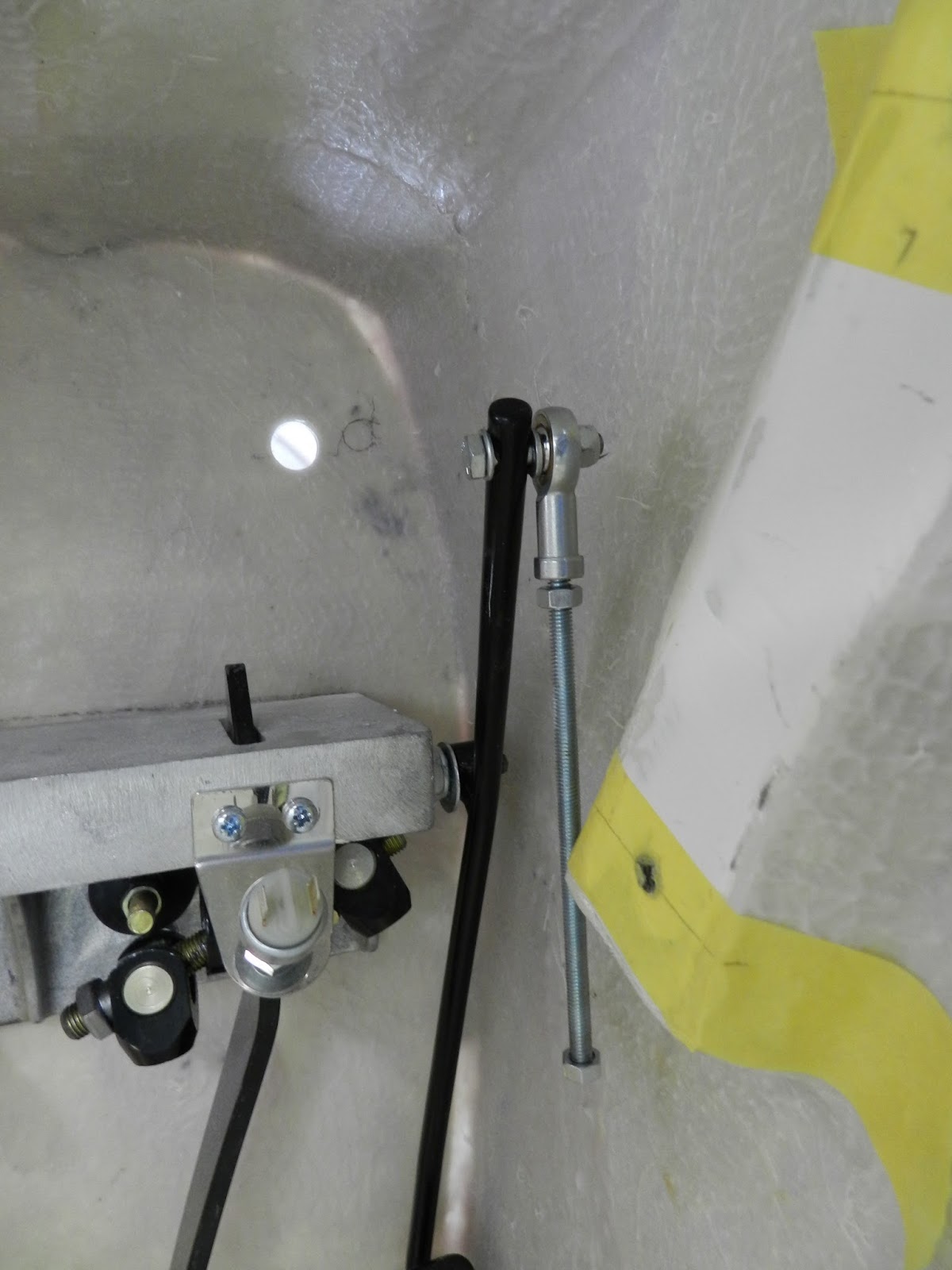
The fly by wire pedal cannot be used as it is, because there is insufficient space in the driver's foot well to use it as it is and its travel is not enough for a progressive pedal. Instead it needs to be adapted and mounted in the off side wheel arch compartment, at the other side of the driver's foot well. A bar is used to connect the electronic pedal to the accelerator pedal on the GD pedal box.

The GD pedal box was installed as normal, after drilling a 6mm hole in the accelerator pedal 10mm down the top part of the accelerator pedal and in-line with the pivot bar i.e. 90 deg to the pedal travel. This was a tricky job and require a drill stand and a drill clamp to hold the pedal - drilling a 6mm hole in a 10mm round bar was not easy! I used gradually bigger drill bits to make the hole.

A 20mm hole was then drilled through the bulkhead in line with the rose joint. I got this wrong the first time and will cover up my mistake with a bolt and washers to fill in the hole!
Bar attached to the accelerator pedal - correct hole marked!
I kept the new hole near to the right side of the driver foot well, to allow the electronic pedal arm to remain as long as possible to maximise the leverage. I was aiming for 100mm of accelerator pedal travel. The electronic pedal only moves by about 55mm.

The foot plate on the electronic pedal was removed. The electronic pedal arm was shortened to fit in the compartment and a new hole drilled. However, I kept the arm as long as possible.
Pedal arm shortened and 6mm hole drilled
The electronic pedal was then fixed horizontally, above the brake and clutch master cylinders, to the bulkhead in the off side wheel arch compartment. Once fully adjusted and fixed in place I will post some photos.

The threaded bar has the two rose joints attached one at each end. Lock nuts are used to secure the rose joints in their final place. One end of the bar was fed through the hole in the bulkhead and attached to the accelerator pedal using a 6mm bolt through the rose joint and the other end was attached to the modified electronic pedal using another 6mm bolt through the other rose joint.


Wednesday, August 19, 2015

Cobra wiring, boot lid, courtesy light switches and windscreen holes

Today I labelled up the front and rear body looms. I followed the GD build manual that identified each group of wires and every individual wire. Really easy even for a numpty like me! At least I know what the wires are for now. It just looked a real jumble of wires before that.

I also found that the GD loom allows for courtesy lights in the passenger compartment, a HiFi system located in the boot and a rear screen heater for a hard top.

I fitted the bullet connectors on most of the wires. The front lights will get waterproof connectors, as they are exposed under the wings.

With the courtesy light wires available it would be rude not to use them. So I fitted courtesy light switches in the door reveal between the hinges. A 10mm hole was drilled in each door reveal between the two hinges, plus a fixing hole.
Hole for switch and fixing
The switch was then located after a small amount of filing to open up the hole a little. The power wire is connected to this switch.
Courtesy door switch installed 
The lights will be fitted later in the under dash panels to illuminate the foot wells. A wire will go from the switch to the light for the power. The earth will then be the second connection to the light.

What I couldn't work out was how the fog and reversing light were earthed and what the two black with white trace wires were in the passenger compartment. Andy from GD clarified this.

The fog and reverse lights use a loop from the earth of the rear side lights (shared earth). Dead easy using a double bullet connection joint (supplied) and a bit of black wire.

The two black and white trace wires are connected together for continuity where the regular GD column connection is used. These two wires allow for an optional brake test light to be fitted. When the wires are connected, the brake test works when the ignition key is set to the crank position.

Fitting the boot lid was not so easy. First the edges of the lid were filed to prepare it for gel coating. Plenty of fitting and removing of the hinges, hole elongation and gentle persuasion of the hinges with a big hammer to get the boot lid lined up followed, along with some choice words! The boot lid took some time to line up and I am still not totally happy with it. I attached the rubber seal to the boot reveal to make sure that I had the correct position for the lid.
Boot lid fitted
GD had pre-fitted a twin core cable within the near side strengthening rib in the boot lid for the number plate light. That saved a load of time and hassle looking at some blogs, however finding the cable at the light end was not so easy. The wire goes through the near side hinge, which I had to drill in two places, down the inside of the rib and then it emerges at the number plate light position.
Boot lid fitted with wire for number plate light shown 
Here the wire is apparently curled up above the light location point and can be hooked out with some thin wire. That is still to do!

Next I cut the holes for the windscreen legs.
Drill holes within GD markings
 The position was marked up by GD. The holes were cut by marking and drilling holes along the centre line, leaving a millimeter at either side. The hole was masked off. Then the hole was opened up using the Dremel, then the step drill (carefully) and a file.

The cut cleaned up with a file ready for the windscreen pilar