Wednesday, August 08, 2018

Northern Cobra Club North York Moors run

It was the Cobra Club Northern annual run this weekend, organised by Mike and Angela Hammond. We decided to just do the Sunday (the run was Saturday and Sunday). The overnight stop and meal was at the White Horse Inn at Rosedale Abbey. Our room was called the Kildale! Sense of humour?

Twelve Cobras had turned out for the run from Rosedale Abbey, ending at the Yorkshire Air Museum at Elvington, near York.
My car in the middle
Most of the Cobras
We travelled up on the Saturday evening, only to find that the battery warning light came on and the voltmeter was showing 13 volts (a little low). After some fiddling with the battery cables and Si Smith shorting out the contacts with his wedding ring (ouch - don't try this at home - the ring gets red hot), we decided that it couldn't be fixed, but was probably ok for the run. However, being cautious, we took the decision to head home. The run back was uneventful - so why did we not do the run?

On Tuesday an auto electrician checked out the car and pronounced the alternator faulty (only done 2,150 miles!). So a new one has been ordered and will be delivered and hopefully fitted tomorrow (Thursday).

Today the oil was changed again (a year since its last change), as a precautionary measure. So 5.5 litres of Mobil's best and a new filter put in/on to the engine at 2,275 miles.

Tuesday, May 08, 2018

Stoneleigh Kit Car Show 2018

Someone counted 85 Cobras on the UK Cobra Club area on Sunday and around 45 on Monday plus over 25 that I saw elsewhere at the show. What a display. Superb!

A view of some of the Cobras on display
Another view with my car in the foreground
Another shot .... of Cobras
My car (again) with the bonnet up
Thanks to all those who came to say hello on Sunday and Monday - I am not going to name check as I will no doubt miss someone off! It really is a privilege to talk to you all. Comments on my car and blog are really appreciated. It was great to meet all the enthusiasts, both people I know and new Cobra owners embarking upon the build process. Good luck to all and hopefully my blog maybe some small help along the way.

Monday, March 26, 2018

Heated seats part 3 - wiring

The supplied relays were fixed to the transmission tunnel behind the seats, using self tapping screws over the carpet.
Relay fixed to the transmission tunnel
The transmission tunnel carpets were lifted along the edge near the floor. The wires were then fed along this area towards the front of the car and up to the central under dash tray.
Wires routed under the carpet, against the transmission tunnel
The earth wire was attached to the ground point on the chassis.
Ground point on chassis
The supply and ground wires were both extended.
Wires extended and tie wrapped in place
20mm holes were drilled in the under dash trays near to the heater outlets. The switch wires were disconnected from the loom and fed through the tray and clicked in to place. They were then reconnected to the looms.

The supply (live) wire was connected to position 3 on the ignition switch, so that the seats only operated when the ignition was on and would not drain the battery if left switched on.

So now to test. Without the ignition switched on, there were no lights on the switches in any position - so a good start! Next the ignition was turned on. A green light when the switch was set to the low setting. A red light when it was set to maximum. And no light at the off/central point - great news.

Now I just need to test it in anger.

Edit: Been out in the car today (Thursday) and the heated seats really work. Brilliant!

Sunday, March 25, 2018

First run out of 2018

Bolted in the seats after fitting the heat pads. Then started her up. Just love the sound of that V8.

To Ilkley, then Bolton Abbey, up to the Strid, over to the outskirts of Skipton, down to Addingham, into Ilkley over the Moors to home. Then topped up with Super Unleaded - the car, not me! Lovely day and great weather.

Good to get out again.

Friday, March 23, 2018

Burley-in-Wharfedale Classic Car Show - 19 August

See over 350 classic cars at the Burley Classic Show near Ilkley. Last year there were Aston Martins, Rolls Royce, Minis, Jaguars, MGs, Triumphs, Jowetts, Austins, Datsun, Land Rover, American cars and much more. Plus a good selection of motorbikes and some steam engines.

There will be a number of Cobras at the show from the Northern Cobra Club, including mine. So if you fancy seeing them and the car featured in this blog, do come along. It is a great day out.

Put it in your diary - 19 August - and say hello!

Saturday, February 24, 2018

Heated seats part 2 - the heaters

The heated seats kit has arrived, along with the staples.
The kit
Unfortunately the instructions are in German! But the company who produced them were very quick with a response to an email and a link to an English version. The wiring diagram was fine and understandable, but I was concerned that there was something hidden in the wording.

First the pads were detached from the loom. The pads were fixed to the foam base and back of both seats using the double sided tape fitted to the pads.
Heat pad in place
This was easy for the base, but I needed to remove more staples from the side (bolster) leather to allow me to get my arm up the back. The latter proved a bit tricky to remove the film from the sticky tape when in place! However, once done and pressed firmly in to place it appears very successful and can't be seen from the outside. Next the leather seat covers were stapled back in place using 8mm staples.

A 16mm hole was drilled in the lower back at the centre and the wires from each pad fed through. An extra layer of tape was wound round the wires, to avoid chaffing, and these were then taped in place facing the transmission tunnel.
The wires at the base of the backrest
A 16mm hole was drilled in the lower back at the centre and the two pad wires were fed through. An extra layer of tape was wound round the wires to reduce the risk of chafing. The wires were made to face the transmission tunnel and taped over. The fixing rails were re-fitted using the original cap head bolts, before the seats were cleaned with leather conditioner. Done.
Seat looks like it did originally

Thursday, February 22, 2018

Head restraints - liberating space

The head restraints supplied by GD restricted how far back the seats could be pushed back. So to address this I modified them! Now I have an extra 40-45mm of travel in the seats.

The head restraints were removed from the seats. The head restraint was placed on a flat surface upside down and by putting a metal ruler against it, a line was marked in chalk 150mm up (so 150mm from the top).
Line in chalk 150mm up
Next the sides were marked in chalk. These side lines were marked from the line across the back parallel down to the metal location bars and finished about 12mm behind the bars (you can see how much will be removed).
Line in chalk across side
The leather cover was then removed by releasing the Velcro and then compressing the foam of the head restraint, taking care not to rub off the chalk lines. The measurement/markings were then transferred on to the head restraint leatherette. The three pieces of Velcro were removed from the cover and retained for later use. I turned the cover inside out and then unpicked the sewn seams at both sides from the bottom up to the line that went across the head restraint. There were two rows of stitches (a hidden seam stitch - black in my case and a top stitch - red for mine). The threads were then knotted on the reverse and a covering of contact adhesive applied. These two actions should stop the stitching unravelling further. The leather cover was put to one side.
Leather head restraint cover removed
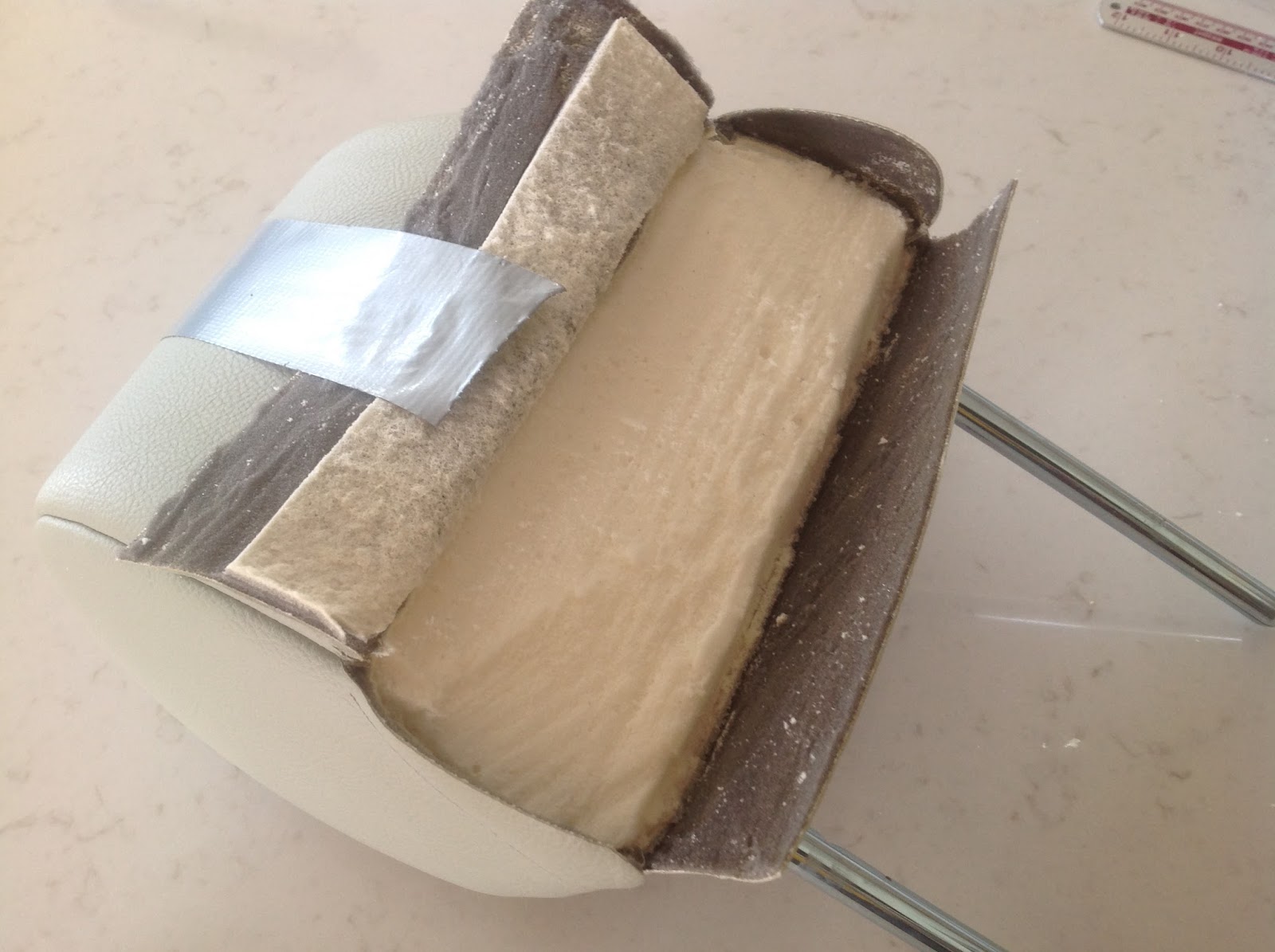
The surface of the leatherette head restraints were then cut downwards from the line drawn to about 12mm from the head restraint location bars underneath. It was then cut across just above the bottom roll (leaving a lower flap for glueing). This formed an H shape cut (see photo below).
Leatherette cut in H shape on head restraint
The leatherette was lifted from the foam underneath. The foam that protruded was removed (try a hacksaw to get a smooth surface, but watch you don't cut any leatherette), as was any residual foam still attached to the leatherette of the back, bottom and side flaps. The top flap had about 5mm removed from the across the bottom (the exact amount can be established by pulling the leatherette tight and marking a line across the flap over a flat area of the head restraint, to remove any excess). The side flaps were carefully thinned, then the top flap was thinned for a strip about 12mm deep across the width. The side flap (a triangle) was marked on the reverse of the top flap and this too was thinned.
Head restraint being operated on!
Contact adhesive was applied to the foam, the reverse of the bottom flap, the reverse of the top flap including the thinned area, the reverse of the thinned side flaps, the leatherette faces of the side flaps, the leatherette face of the lower flap (about 10mm across the width). Once touch dry, the bottom flap, followed by the side flaps were pressed in to place. Finally the larger top flap was pressed in to place on to the foam.

The cover was fitted over the head restraint and the new position of the Velcro marked with chalk. The cover was removed, then the Velcro was glued and machine sewn in place. The stitching was redone by hand, down 45mm below the chalk line - both the seam and the top stitch. The remainder of the seams were simply top stitched for continuity. Finally, after refitting the cover again, it was tightened in place, using the Velcro. The remaining bits at the bottom corners were glued in place to make a neat job.
Head restraint in place liberates about 40mm of extra seat travel,
a further 70-75mm is available if the head restraints are not fitted.
The modified head restraints have removed a fair bit of the padding at the bottom back which touched the rear bodywork. This now allows the seats to be pushed back a further 40mm or so.