Tuesday, November 17, 2015

Cobra chassis is born

Steve Hughes picked up his GD427 body and parts today. He saw my Euro chassis being prepared and took photos. I decided to have it powder coated in black. So here it is before it is kitted out as a rolling chassis by GD!
View from the front
View from the rear

Monday, November 16, 2015

Tyres and stoneguards fitted!

Tyres

I had Michelin Pilot Super Sport tyres fitted at home today. 245/40/ZR18Y at the front and 275/40/ZR18Y at the rear.

The wheels were delivered to my house directly from Image, although I had ordered via Gardner Douglas. This was no more expensive than ordering direct from the manufacturer, so well done GD. Having them fitted on the drive saved me having to take the wheels to a fitter and also having to wait around at a fitters place, kicking my heels.

I used "tyresonthedrive.com", they were competitive on price and fitted the tyres and balanced them at home.  I could have bought just the tyres cheaper, but then I would have had fitting and balancing costs, plus fuel to get to a fitter and all the hanging about. So in the end it would have cost me more.

An email in the morning reminded me that the tyres would be fitted today. The fitter (James) arrived on time as promised, in his van with electric fitting and balancing on board.
Tyresonthedrive - tyres being fitted
The centre nut cover and spinner was removed from each wheel first. The tyres were fitted without any fuss in about an hour and paid for at that point. Now if all services were that good!
Tyres fitted
Now I just need to remember to take them to GD when I collect the chassis (this looks to be delayed a bit at the powder coaters according to Andy).

Stone guards

Black stone guards contrast nicely with the white body. Black was not only chosen due to the contrast, but I know from experience that the Caterham's stainless guards were wrecked within a few weeks due to stone chips. Carbon fibre are available, but the cost was more than I wanted to pay and I couldn't find proof that they lasted much longer. That left GRP which can be rubbed down, filled and polished back to new if required.
Stone guard and rubber U channel strip
Black rubber U-channel edging was fitted around each stone-guard. The guards were fitted with a black rivet in the corner nearest the body. A hole was drilled in the corner closest to the body to accept the rivet. Then two black self tapping screws were used to fix each guard to the wheel arch return.
Stone guard fixed in place
The wheel arch was then dressed back to the stone guard, so that there was no white showing. How good does that look?

Can't wait for the chassis now!

Sunday, November 15, 2015

Brake and clutch pipes

The brake and clutch master cylinders had been fixed in place and so had the flexible braided hoses that will connect the body to the chassis union. The positions on the chassis connection block are nicely etched on from what I have seen. The silicone hoses that link the reservoirs to the master cylinders were also in place, but as yet not connected. So 'all' that was required was to connect them. Easy ..... or so I thought!

The 'output' braided hoses (pressure) had already been attached to the inner wing using the three 10 mm holes and the 'input' silicone hoses (from the reservoirs) had been fed through the three 15 mm holes I had drilled earlier in the inner wing between the engine bay and the compartment behind the wheel arch. The input and output hoses had been installed in the following sequence (from the front of the car):
  • Front brakes
  • Rear brakes
  • Clutch
I had installed the brake and clutch cylinders in the same order on the bulkhead from left to right (when viewed from within the compartment behind the off-side front wheel).
  • Front brakes - 0.75" cylinder
  • Rear brakes - 0.625" cylinder
  • Clutch
Clutch pipes

The copper clutch pipe was identified in the GD kit (it was the shortest one marked No. 10 on the yellow sleeve). The silicone hose from the clutch reservoir to the clutch master cylinder, was connected to the white plastic hosetail, using a pipe clip to secure it. The plastic union was removed from the master cylinder to make this a bit easier. The copper clutch pressure pipe was bent so that it fit between the front of the clutch master cylinder and the rear braided output hose (see blow).
Clutch master cylinder with connections made
Brake pipes

Now read this carefully and take on board. I hadn't!

I had initially tried to connect the unions pre-fitted to the brake pipes to the front ports, assuming that the input pipe would go to the rear ports, like the clutch cylinder. After a conversation with Andy, who was totally confused with what I was doing, it turned out that I had been trying to fit the Jaguar unions in to the two master cylinders that had been supplied. Andy thought that he had explained what was needed to me, hence the confusion.

The rear ports are actually 3/8 UNF and take the pressure pipes. The front are 7/16 UNF and take the silicone input pipes from the reservoir, via brass hosetails.

I had not appreciated the correct fitting or the changes required. So the brake pipes had been bent before I realised that the fittings on the pipes were wrong and that I was trying to fit them in the wrong holes!

I didn't have any of the unions which should have come with the brake pipes/cylinders. After the conversation and a few photos by emails, Andy at GD put me on the right path and sent me the missing parts.
The brake unions
The unions on the pipes supplied by GD, No. 11 and 12, needed changing to the 3/8 UNF unions (the bottom two in the picture above). My flaring tool kit came in useful for this (the pipes were originally for the Jaguar tandum master cylinder which uses M10 and M12 connectors, my car has two separate brake cylinders connected via a balance bar). Are you still following this?
The bent brake pipes plus the unions that need swapping
So with the correct fittings on the copper pipes and the brass tails for the silicone hose I started again.

Remember that the brake pipes are attached to the rear output holes. This is the reverse of the clutch master cylinder just to make things more interesting. The copper brake pipe was re-bent and attached, so that each pipe linked the cylinders to the appropriate braided hose previously fitted. I found that attaching the pipes to the master cylinder first, then to the braided hose fittings on the inner wings was the easiest method to avoid cross threading (loosen the nuts on the braided hose first).
Copper pressure pipes attached to the rear ports
The silicone hoses were then connected to the new brass hosetails (remember to use the supplied Dowty washers - the ones with rubber around the inside) on the front of each brake cylinder. The hoses were clamped in place with pipe clips.
Silicone hoses from the reservoirs in place
Now, when Andy checks the brakes before the IVA test, he may need to swap the master cylinders around to get the correct pressure at the back and front!

NOTE: This wasn't required, but the balance was corrected as expected.

Saturday, November 14, 2015

Fuel filler cap

Mr IVA has a requirement (not unreasonable), that all fuel filler caps are tethered to the car so that you can't drive off from the petrol station and leave your filler cap behind! The flush cap as supplied, was not tethered to the filler neck. An Aston type filler would not need this work.

I used picture hanging cable, the brass looking stuff, as it was thin and corrosion resistant.
The cable and fixings. The 'modified' connection is on the left see below
The cable was to be attached to the filler cap, then to the neck of the filler itself. About an 200mm length of this cable was required for this (plus the amount needed to secure the cable - in my case an extra 80 mm).

To achieve this, a hole was drilled in the bottom plastic part of the cap, taking care not to affect the locking mechanism. The cable was fed through the hole and secured to itself using a modified electrical connector. The 'modification' is a pompous way of saying cut off the connection part and discard it!
The cable attached to the black plastic of the filler cap
The other end of the cable was attached to the filler neck. Here a small hole was drilled in the bottom of the neck to take the cable. A small channel was also cut in the filler neck, with the Dremel, to allow the cable to be flush once the pipe that connects the filler neck with the fuel tank is fitted.
The filler neck showing the hole and channel
This secures the filler cap to the filler neck and should satisfy the IVA requirements.
The finished tether


Wednesday, November 04, 2015

Wheels arrived!

The wheels have arrived from Image Wheels. I had decided to go with black centres, annodised rims, nut covers and spinners. I had Image wheels on the racing Radical, so I am confident that they will be okay. They are their GTD5 Halibrand replica style at 18" diameter, 8.5" wide at the front and 10" wide at the rear!
The four wheels with spinners and nut covers
Now I just need to organise some tyres, prior to collecting the chassis from GD in Newark. The GD preferred tyre sizes are :
  • front 245/40/ZR18 Y
  • rear 275/40/ZR18 Y 
I will go for Michelin Pilot Super Sports as they are rated as good in the wet/damp, are excellent in the dry,  have good reports for comfort, are rated as one of the fastest tyres, have raised ridges around the tyre bands to help defend against kerbing and get great reviews. They sound pretty good!

Tuesday, November 03, 2015

Boot lock, bonnet rubbers and fuel filler breather

This was a job I have been putting off!

Boot lock

First I marked the centre of the car (this is not as easy as it sounds!), then using the lock, handle and striker plate, I marked the square bar position in relation to the top of the striker plate (at this stage it is not possible to work out the hole location in the boot lid).
Centre line marked
The round bar on the striker plate was aligned with the edge of the square bar to the left of the centre line, so it was about 2.5 mm off centre (to the near side of the car) of the square bar.
Centre line with striker plate located. The striker bar looks further away from the centre line than it is.
The distance is half of the square bar to the near-side of the centre line.
An undersize hole was then cut (in case I made a hash of it) with the Dremel, where the claw of the lock would go. The striker plate was fitted to the car with button head screws and nylock nuts.

I then climbed in to the boot to mark out the position of the lock mechanism. The position was identified by hooking the claw around the striker plate bar and getting Carol to press lightly on the boot lid from outside (she let me out eventually). The lock fixing holes were then marked and drilled. After fixing the lock in place with self tapping screws, a 3 mm pilot hole was drilled in the boot rib, using the square hole in the lock as a guide.
Lock first fit and pilot hole drilled through boot rib
The pilot hole was opened out to 10 mm using a stepped drill, to avoid chipping the gel coat. A hole was then drilled through the outer skin, using a 3 mm bit from the boot side, which emerged very close to the centre line. Using the pilot hole, the external hole was then drilled to 20 mm.
The two holes (one in the outer skin and one in the inner skin) can be seen in the boot lid.
The outer skin hole was opened up to centralise and locate the handle. The slots were cut for the locating lugs. The handle was fixed with the two self tapping screws after the square bar was pushed through the lock.
Loosely fitted handle, square bar (too long at this stage) and lock.
The square bar was marked then removed with the handle. It was then trimmed to the marks so that it was flush with the lock. The lock was then finally refitted and the handle put in place.

Lock fitted in place and tightened up
A small amount of silicone was applied to the handle fixing, before final location. Nice feel when closed and locked!
Handle fixed in place
Whilst I was at it, I fixed the number plate light, where the chrome cover would not tighten up - the thread had stripped. Here I super glued a standard nut behind the hole on the light unit. The fixing bolt was then put in place and tightened.

Bonnet rubber strips

This was an easy win! 

The black sealing strip was fixed in place, using the self adhesive backing. It is not a continuous run around the bonnet shut line, but rather three separate strips. This apparently allows some ventilation and avoids the bonnet being raised too much above the body line, which a continuous run would do.

The edge closest to the windscreen was run from the edge of the curve of the bonnet shut line on the off side, across the car, so that it was equal length from the near side corner. See photo below.

The side strips were then cut to the same length as each other and fixed to the shut line from the end of the corner nearest the windscreen, towards the front of the car. See photo below.
Rubber seals in place
This raised the bonnet very slightly, but with a slight compression it allowed the locks to operate and close without any free play. Sorted!

Fuel filler breather

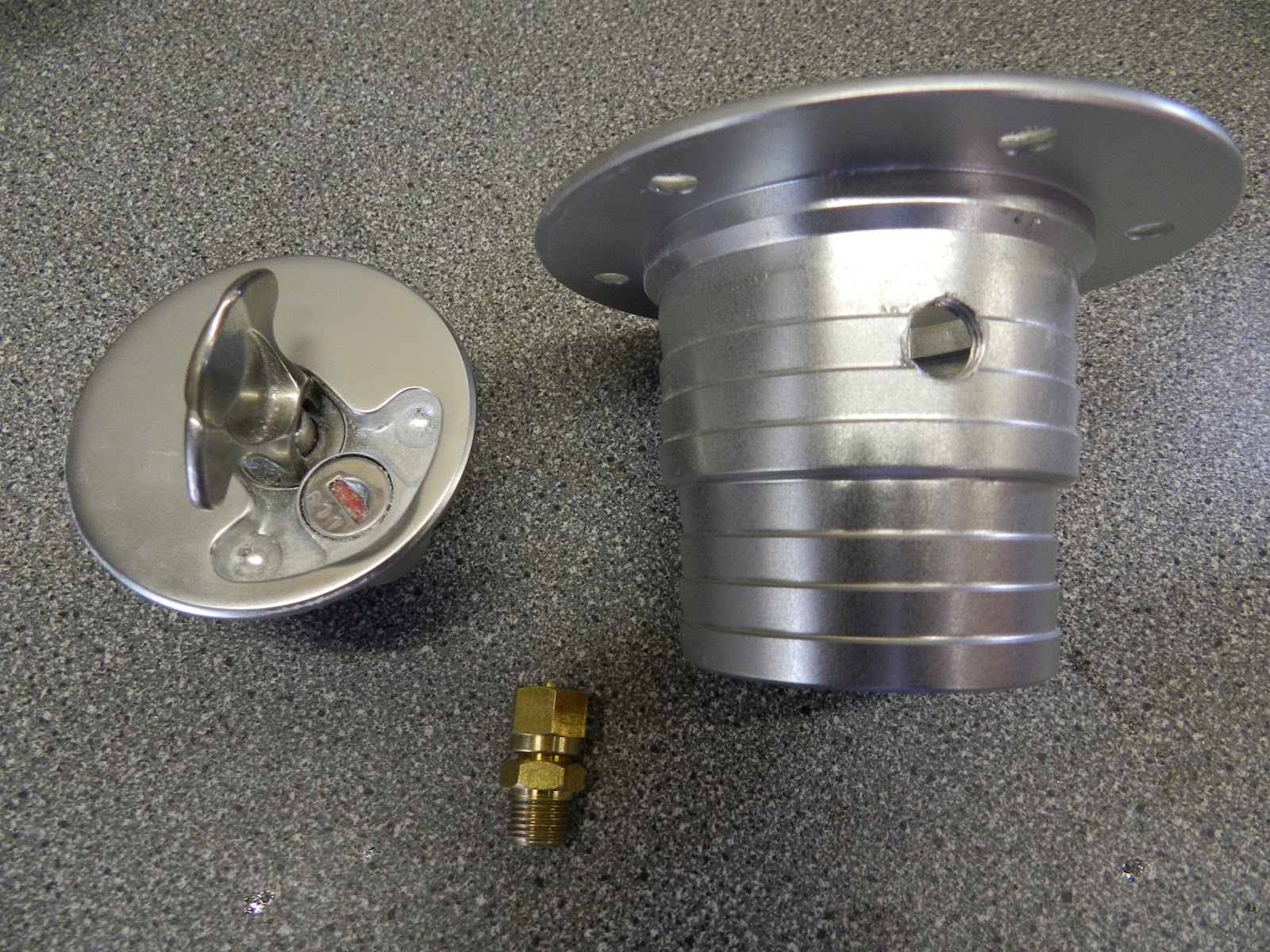
A breather adapter was required for the fuel filler.

An 8 mm hole was drilled in the neck of the filler. Care was needed when selecting the position so that the cap would still fit and lock once the breather adpter was in place. The hole was tapped to 1/8 NPT. This may seem an odd thread, but I had a tap already in my Draper metric tap and die set!
Filler, cap and adapter
The filler cap was put loosely in place on the body. A small amount of nut lock was applied to the thread of the fitting before it was screwed in place. 
Breather hole can be seen in the neck 
The filler was rotated so that the breather was facing towards the drivers door, before fixing with the six fixings provided. 
Breather position viewed from inside the boot towards the off-side rear wing
Copper pipe brake pipe will be added later. This will need to be in an 'S' shape and use the compression fitting of the adapter. The other end will go through the boot floor - I need to remember to keep it away from the exhaust or Mr IVA will not like it. Don't think I would either if it ever vented fuel out there!

Sunday, November 01, 2015

Final windscreen fixing

Previously I had trial fitted the windscreen without bolting it in place and then I had removed it. Hopefully this is the final fixing!

The stanchions were removed from the screen by undoing the four fixing screws on either side. The stanchions were then drilled, using a conical stepped drill, a drill and drill stand at the pre-determined places, to accept 8 mm button head machine screws. I had been warned that the stanchions were chromed brass and brass is liable to grab when drilled, so I had used the conical stepped drill with care. I had to turn the stanchions over and drill from the other side to get an 8 mm hole all the way through - had to do this due to the depth of the step on the bit.

The drilled stanchions were then re-attached to the screen and the screen put in place. Carol (my better half) came to my rescue here and lent a hand, as with over £550 of screen I didn't want to damage it. The screen position was checked and the bottom locating bolts/holes were opened up very slightly. A round file did the trick here. Penny washers were used to make up the small gap in between the fixed screen mounting points and the stanchions to avoid putting stress on the screen.
Near-side stanchion from inside the passenger compartment
The screen should be about 6mm off the scuttle at the outer edges and the top should be 930mm from the rear of the cockpit roll. The measurement from the first sun visor screw hole (I used this point as it was a good fixed reference) to the rear of the door openings should be close to the same on each side - in my case 810 mm. No need for the temporary locating templates that many of the older builds have entailed. All the measurements were correct - whoopee! Well done GD.
Windscreen in place
The screen was then unscrewed from the stanchions, leaving the uprights in place.


Stanchion with silicone sealer
The slots were sealed using silicone and then each of the escutcheons was fed over the stanchions. The escutcheons were bent to the shape of the body and then fixed using two self tapping screws. A small amount of silicone was used to seal the escutcheons.
Windscreen escutcheon

The under dash cross bars were fitted to the same holes as the screen stanchions. a small amount of silicone kept the penny washers in place! Ideally this whole job should have been done when I fitted the stanchions and before I siliconed the things in place - it would have been a bit easier!
The two cross bars fitted
The way the two bars are fitted can be seen in the photo above. They were secured using the button head screws that fixed the windscreen stanchions to the body.
A view showing the two cross bars in place
The two bars with the fixing lugs for the central under dash tray
Holes were drilled down through the transmission tunnel and rivnuts fitted to secure the larger bar to the tunnel. This can't be done finally until the carpet if fitted.
A side view of the fixing, where the rivnut and screw can be seen
Other shiny bits

Whilst I was at it I fixed the door hinge escutcheons. I like this bling stuff - must have been a magpie in a former life!
Shiny bits. Also you will see the courtesy light switch between the hinges
Just needed to open out the holes a little with a flat file to avoid the hinges touching the bit of the escutcheon that fits in to the hinge hole.

New link

I have added a new link to Jonathan's Cobra build - see 'Some other GD427 Cobra build blogs that may interest you' to the right of this post. Jonathan is the guy in the Shetlands who has just taken delivery of his GD.