Monday, August 31, 2015

Drilling and cutting

Heater

First the holes were cut to allow air to get to the heater which is located in the nearside compartment under the wing. Five 22mm holes were drilled at equal intervals in the nearside wing air intake. The off side vent is purely for show.
Holes drilled in air intake
The heater is fixed in the nearside footwell compartment.

The sides of the heater were removed, and the flanges cut off as they make the heater too wide to install. This is simply a case of removing eight self tapping screws to remove the sides, then cutting off the flanges with a hacksaw and trimming up with a file.

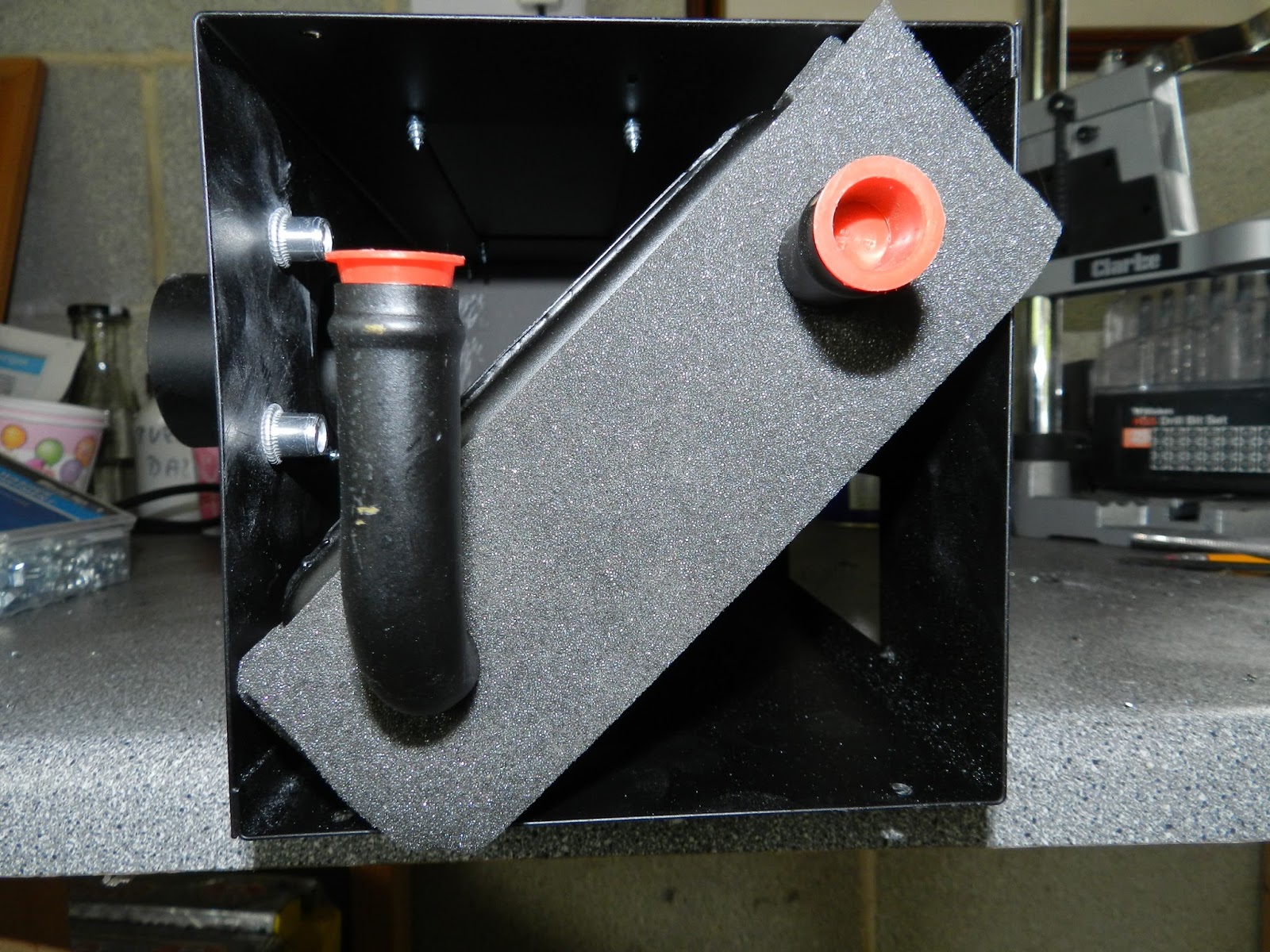
The internals of the heater were removed, before four 6mm rivnuts were installed - the top about 30mm in from the sides, the bottom 20mm from the sides and 5mm above the centre line of the existing screws (see below). This avoids the heater matrix and gives room to fix the bolts in to the heater from the footwell.
Heater with flanges removed
Side view of the heater with the matrix in place and the rivnuts installed
Now to installing the heater unit. First I measured where the water feed pipes were to go. GD had marked the line up in the engine compartment. The water feed pipe hole positions were marked as were the two main hot air pipes (shown above). The holes were cut - 25mm in diameter and 65mm apart for the feed pipes and the appropriate size holes cut for the hot air pipes. These were opened out a little with a file to allow the pipes to go through to the footwell.
Hot air pipes in the footwell (the relays have been temporally removed)
The heater in the nearside compartment ahead of the passenger footwell.
Here you can see three of the five vent holes on the right
A template of the face of the heater was used to mark up the positions of the rivnuts from the footwell. Now it's just a case of fitting all the pipes and fishtail vents to the scuttle!
Door reveal

You can just about see the marked lines for the cut out behind the door (not sure what these are for!). I drilled a hole at the corner to make the cut neater.
Cut out marked behind nearside door
Below you can see the area with the section cut out. I used the flexible extension for the Dremel, as it was a little less bulky than the main drill.
Area cut out
Extended footwell

The extended footwell gives you more space for the size 9s. The pedals in the GD are off-set to the right and without the extension it is quite cramped. Beware if fitting the footwell extension though. If I had cut the bulkhead using the extension as a template, the hole would have gone in to the offside compartment under the wheel arch. Luckily I drilled a hole to test and found this out.
You can see the line that would have cut if I had used the extender, plus the test hole 
Once the hole was cut, I fixed 6 x 5mm rivnuts to the extender to bolt it in place. There is a gap between the extension and the engine bay wall that I will have to deal with.

Sunday, August 30, 2015

Painting the metalwork

I changed my mind. The cost of powder coating was nearly £200, so I decided to paint the hinges etc myself - cost around £60. I used chassis black POR15 paint. This may be a better option, as my experience/opinion of powder coating is not good - it has lifted and flaked on previous race car chassis.

Before painting the metalwork needed preparing by removing all the sharp edges, so that rust wouldn't break through at these points. All the threaded holes and pivot points had previously been filled with plastercine to avoid paint getting in to them.
The metalwork before preparation
Once this was done the metal was prepared by using POR15 Metal Prep. Finally the bits were hung up and painted with POR15 chassis black paint. the stuff runs and two coats are required, but it is self levelling, so produces quite a good finish.
I knew that the caravan airer would come in useful sometime
The paint can warns you not to shake it, to take out what you need (rather than using it from the can) and to use cling film between the lid and can, to stop it gluing itself together. Not your normal paint then!

The metalwork was given a second coat, to make it solid.

Saturday, August 29, 2015

Wiring

Snatched a couple of hours today and fixed the under bonnet wiring loom in place.

The loom was secured with 13mm P clips to the inner wing with 5mm machine screws and nyloc nuts, concealing the rear to front wiring under the bonnet lip where possible.
The loom concealed under the bonnet rim
Part of the wiring loom then passes through the nearside inner wing, to supply the lights, indicator and indicator repeater. A hole needs to be drilled to take a suitable sized grommet. The nearside repeater wire, which runs front to rear on the otherside of the inner wing, was also fixed with 6.5 mm P clips, sharing the same 5mm machine screws (avoided drilling more holes), before entering the compartment at the rear of the wheel arch.
Nearside wheel arch showing repeater wire P clipped in place
The loom is then run across the front of the car and attached to the bonnet hinge mount, again with P clips secured via M5 rivnuts. This leaves loose wires (at this stage) for the horn and fan.
Looking at the bonnet hinge mount from the 'grill' at the front
The wiring across the hinge mounting has sufficient slack (hence the curve in the wires) to allow for the air intake vent, of which more later.

The off side wiring loom (again lights, indicators and indicator repeater) then passes through the inner wing, after drilling a suitable hole. The repeater wiring runs front to rear and was clipped to the top of the wheel arch side of the inner wing using 6.5mm P clips. Now it is just a case of wiring up the items.

In my infinate wisdom I had bought some waterproof connectors for the front lights and indicators. This was because the joints are under the wings and exposed to any damp or wet - not that I plan to drive it in the rain. Easy to fit in theory. Less easy in practice! What a fiddly job.


Wednesday, August 26, 2015

Underseal

Yep. More underseal!

I applied masking tape to the underside of the wheel arch return and the back of the transmission tunnel to avoid getting underseal on these areas.

The underseal was stirred well and applied by brush. Don't leave the brush overnight in white spirit hoping that it will be clean the next day. Instead it will be set rubber. Voice of experience! But at least the white spirit will be clean.

I have done all the wheel arches and the nose cone twice. I also used masking tape to create a straight line under the bonnet just below the wing to the inner wheel arch joint. I paid particular attention to coating the tops of the wings and wheel arches. It is hard work undersealing this! The whole job is a two day task.

The nose cone area runs up to the underside of the bonnet surround and on each side.  I have left the front of the inner wings untreated at the moment. I will finish off to the line of the radiator once I know where this is. See the photo below for the current position.
Undersealed nose cone, with IsoFlex tin centre bottom
In addition I have coated the area around the rear axle/the diff. although this is not really required.
Rear arch area where differential will go
I have not done the transmission tunnel, as again it is not really required.

Sunday, August 23, 2015

Wiring success!!

A variety of jobs today.

Number plate light

I managed to get the number plate wire pulled through ..... eventually! After about an hour of trying to hook the wire through the hole I had made in the boot lid, I gave up and drilled a hole from the other side of the boot lid.

Not pretty, but it did the trick! Now needs filling and gel coating
The wire was hooked through this hole, then a draw wire attached to pull it up the channel to the number plate light location. A grommet will be used to fill in the hole.
Wire pulled through
This wire was threaded through the light base and the fitting attached. Then the bullet connectors were soldered on.

Number plate light fitted
Door hinges etc

Next the doors were removed, so that the metalwork could be painted, the lip cut back and the gel coat on the edge rubbed down for the first time.

The gel coat rubbed down ok, but showed the GRP below in places. So more gel Coat was mixed and applied. The joint between the inner and outer skins needed a good coat or two of gel.

The tapped holes and the pivot holes on the metalwork, were filled with plasticine to make sure that they were not covered in paint.

Door aperture

In the meantime the edges around the door apertures were marked from the door side to give a consistent 12mm lip all round. A small block of wood was used for this and a screw fixed so that it stuck out a small way to scribe the cut line. The trusty Dremel was used to remove the excess. Watch the cutting blade! They have a habit of breaking and flying off
Lip cut down to 12mm
Wiring

I drilled 24mm holes through the inner wing for the front loom and the 12mm holes to the under wing compartments for the indicator repeater cables. The hole sizes all allow for the grommets I used. The GRP was thinned down around the four holes and Vaseline used to allow the grommets to fit. The cables will be held in place by various size P clips, once I have long enough cap head bolts of the right size.
Underseal

I undersealed just the one wing today - it is important with GRP cars that underseal is applied to reduce the risk of star crazing, caused by stones flying off the wheels and hitting the underside of the wings. I used IsoFlex (available from big DIY stores and builders merchants), as others had used this product. But, forgot to put on rubber gloves - it goes everywhere! It has the consistency of a thick paint or golden syrup!
One done three to go and then its a second coat! The yellow is masking tape to protect the wheel arches.
Just three more wheel arches and then another coat.


Wednesday, August 19, 2015

Cobra wiring, boot lid, courtesy light switches and windscreen holes

Today I labelled up the front and rear body looms. I followed the GD build manual that identified each group of wires and every individual wire. Really easy even for a numpty like me! At least I know what the wires are for now. It just looked a real jumble of wires before that.

I also found that the GD loom allows for courtesy lights in the passenger compartment, a HiFi system located in the boot and a rear screen heater for a hard top.

I fitted the bullet connectors on most of the wires. The front lights will get waterproof connectors, as they are exposed under the wings.

With the courtesy light wires available it would be rude not to use them. So I fitted courtesy light switches in the door reveal between the hinges. A 10mm hole was drilled in each door reveal between the two hinges, plus a fixing hole.
Hole for switch and fixing
The switch was then located after a small amount of filing to open up the hole a little. The power wire is connected to this switch.
Courtesy door switch installed 
The lights will be fitted later in the under dash panels to illuminate the foot wells. A wire will go from the switch to the light for the power. The earth will then be the second connection to the light.

What I couldn't work out was how the fog and reversing light were earthed and what the two black with white trace wires were in the passenger compartment. Andy from GD clarified this.

The fog and reverse lights use a loop from the earth of the rear side lights (shared earth). Dead easy using a double bullet connection joint (supplied) and a bit of black wire.

The two black and white trace wires are connected together for continuity where the regular GD column connection is used. These two wires allow for an optional brake test light to be fitted. When the wires are connected, the brake test works when the ignition key is set to the crank position.

Fitting the boot lid was not so easy. First the edges of the lid were filed to prepare it for gel coating. Plenty of fitting and removing of the hinges, hole elongation and gentle persuasion of the hinges with a big hammer to get the boot lid lined up followed, along with some choice words! The boot lid took some time to line up and I am still not totally happy with it. I attached the rubber seal to the boot reveal to make sure that I had the correct position for the lid.
Boot lid fitted
GD had pre-fitted a twin core cable within the near side strengthening rib in the boot lid for the number plate light. That saved a load of time and hassle looking at some blogs, however finding the cable at the light end was not so easy. The wire goes through the near side hinge, which I had to drill in two places, down the inside of the rib and then it emerges at the number plate light position.
Boot lid fitted with wire for number plate light shown 
Here the wire is apparently curled up above the light location point and can be hooked out with some thin wire. That is still to do!

Next I cut the holes for the windscreen legs.
Drill holes within GD markings
 The position was marked up by GD. The holes were cut by marking and drilling holes along the centre line, leaving a millimeter at either side. The hole was masked off. Then the hole was opened up using the Dremel, then the step drill (carefully) and a file.

The cut cleaned up with a file ready for the windscreen pilar

Sunday, August 16, 2015

Front and rear wiring loom

I decided that the wiring loom would be next. This is in four parts:
  • The front
  • The back
  • The dash
  • The engine
Today I tackled the first two. It was difficult to work out where things went and the GD build guide did not give all the details or photos. It is fine once you have worked it all out or know what you are doing!

NOTE ADDED LATER:  Clearly I didn't know what I was doing! At this stage make the modifications to the column switch wires, the washer earth, the horn wiring (as per the GD instructions) and feed the red wire for the fuel pump through the bulkhead. Do it at this stage to save you time and grazed knuckles.

First I decided to fit the front loom. The fuse box hole was cut out as marked by GD. The fuse box was fitted through the hole. In my wisdom I thought that the fixing holes could be marked by putting the fuse box in place from the engine bay side and marking the fixing holes, then drilling. Wrong!! They are not central and are not the same when the fuse box is mounted from the other side.

Holes drilled in wrong place!

Put the fuse box through the hole, then mark and drill from the passenger compartment. Fix with cap head bolts. Some filling and gel coating to do then.

The relay block was fixed in place with self tapping screws to the scuttle between the windscreen fixing point and the front of the passenger foot well. Note that this is fixed upside down. By removing a couple of relays fixing holes are revealed. I was a little concerned that the pilot holes would come through the wings! Of course they didn't.
Relay block fitted
A 44mm hole was drilled in the near side inner wheel arch where GD had marked. The front loom was fed through the hole and the grommet fitted in place. A little Vaseline in the grommet groove helped fit the grommet in the hole.
Hole cut, grommet fixed and loom fed through.
Next the rear loom was connected to the front loom. There are two electrical terminal blocks to push together. These are unique so can't be mixed up.

A pilot hole was drilled from the boot towards the passenger compartment then opened up to 25mm. I avoided drilling through the panel in the upper area of the passenger compartment. A piece of wire helped me locate the hole from the passenger compartment.
Pilot hole drilled from boot
Once the hole was drilled a slot was created about 10mm wide to help thread the loom from the passenger compartment to the boot. This slot can be seen in the next photo. Threading the numerous wires through took some time.
The rear loom behind the seat location
The rear loom once connected, was routed down the front firewall into the foot well. It then went along the line of the transmission tunnel. From there it went behind where the passenger seat will be and up the rear fire wall, before entering the cut slot/hole. 'P' clips will be needed to retain the loom - something to source.
Holes cut for dash loom
Another 44mm hole was cut. This time in the bulkhead. Below this a 25mm hole was cut both for the dash loom. GD had marked the holes.
Hole cut for steering column
Finally a 60mm hole was cut for the steering column. Again GD had marked the hole.

Next I need to mark up the numerous wires so I know where they go. I will use the wiring diagram in the build manual to do this.